
October 18, 2007


October 12, 2007
The Myth of the North
It was with a mixture of nausea and exhilarating irritation that I had to visit the worst modern building I know: the Lowry Arts Centre (www.lowry.com). I find myself in that odd bind where something is so appalling you want to warn people not to go near it but at the same time wanting to recommend it so that you can share the adrenaline rush of experiencing something truly jaw-dropping. There is one angle that I don’t mind the Lowry from – that is on Google Earth where you can see that it was designed with some cube, circle, triangle structure. But from the ground it is an absolute stinker. There is no architecture logic from the outside, but when you go inside there is no human sense to it. It is no exaggeration that it makes me feel physically sick to be in there too long. If the spaces had been designed as a centre for Overactively Disordered children with colour blindness it would be excusable but the glaring juxtaposition of brutal purples with orange, red and yellow garishly slanting off at made angles, floors that slope illogically while adding the colours and texture of public toilet blue flecks is maddening. I wouldn’t ordinarily mention this as the building has been there for a few years now and, while it has the same effect on me each time, it is hardly noteworthy. As usual (on my rare visits), I despair at the clumsy geometry and bad lighting of the Lowry galleries themselves; so nothing new there. There is a brilliantly bad column in one of the galleries blocking a series of sight-lines in front of some Lowry drawings which I always make the effort to visit just to confirm to myself that the architect who laid out the spaces was an idiot.
The thing that especially fired me this time though was the current temporary exhibition. Generally the Lowry exhibition programme is not very exciting – maybe the badness of the spaces infects that too – but the current show “the Myth of the North” actually magnified the general annoyance of the Lowry experience. Curatorially the display is fabulously poor – half-arsed ‘sets’ of stereotyped back-to-back terraced housing, daft plastic stone/brick walls, one enjoying the set piece of an umbrella and a suitcase leaning against it. There seems to be no curatorial thread running under these dismal displays. The brochure says that it is “an amused look at how others have chosen to see us”, but by the curation says that is how the Lowry curators see us as well. Lowry’s own paintings are done no favours in this environment (these are supposed to be the guardians of his work!), by association with the tedium of these northern stereotypes Lowry is relegated to being a local painter of local, now extinct, scenes of grime. A sorry state of affairs. A much more insightful show of Northern-ness is the Factory exhibition at Urbis http://www.urbis.org.uk/page.asp?id=3149 – among other things an exhilarating example of what is achieved if a phenomenon is driven by inspiration and creativity unencumbered by a business plan and target bollocks.
The thing that especially fired me this time though was the current temporary exhibition. Generally the Lowry exhibition programme is not very exciting – maybe the badness of the spaces infects that too – but the current show “the Myth of the North” actually magnified the general annoyance of the Lowry experience. Curatorially the display is fabulously poor – half-arsed ‘sets’ of stereotyped back-to-back terraced housing, daft plastic stone/brick walls, one enjoying the set piece of an umbrella and a suitcase leaning against it. There seems to be no curatorial thread running under these dismal displays. The brochure says that it is “an amused look at how others have chosen to see us”, but by the curation says that is how the Lowry curators see us as well. Lowry’s own paintings are done no favours in this environment (these are supposed to be the guardians of his work!), by association with the tedium of these northern stereotypes Lowry is relegated to being a local painter of local, now extinct, scenes of grime. A sorry state of affairs. A much more insightful show of Northern-ness is the Factory exhibition at Urbis http://www.urbis.org.uk/page.asp?id=3149 – among other things an exhilarating example of what is achieved if a phenomenon is driven by inspiration and creativity unencumbered by a business plan and target bollocks.

September 30, 2007
A personal post
For various reasons, it was my intention not to waste readers' time with personal details. Until recently, when it was pointed out to me that the odd thing that slipped in was becoming the raw material for someone writing a poem using my personal words. Marguerite Heywood has now sent me the poem, here it is:
The personal words of Tony Trehy
as a city boy I steered clear
of all this outdoor Romanticism
although personally I don’t subscribe to this equation
that makes a child death more meaningful
I
don’t often mention Galleries in Manchester though
I visit them frequently
as a city-dweller, I’m not sure that I would class fishing rods
as “everyday objects”, but maybe books are
ok why should I suffer alone
o fuck
paradise for me would be a cross
between Berlin, Venice, Manchester
people, noise, excitement, food, culture
it is going to sound like I am in grumpy mood
no wonder the majority of us have moved to cities
fired or maybe sometimes bored by the academic analysis and the power of the ‘actual’ work, I deserted for a time to write a poem in response to it
but ever since I was a teenage artist
it’s been a while since I visited the Park
I had a writing deadline of my own to hit
so I was out and about
writing and thinking in the Spring sunshine
someone who
I have never met and
I expect has never heard of me
I will never live in this town
what could be more invigorating
than sitting in the studio
of one of German’s leading sculptors
writing while he works
I first complained
to the Bury Librarian
and sent an alternative list
I think the definition of fame (in case there are any pedants out there) is
you are famous when someone knows you and you don’t know them
sadly I am too slow a reader to make a dent in this fabulous pile
for about 30 years I have bought (literally)
into a personal future plan believing the wisdom
that saving for the future was a vital part of your life at the end
I will be poor and ill
I am suddenly much richer to live my life now while
I can enjoy it a small resistance
be every little helps
The personal words of Tony Trehy
as a city boy I steered clear
of all this outdoor Romanticism
although personally I don’t subscribe to this equation
that makes a child death more meaningful
I
don’t often mention Galleries in Manchester though
I visit them frequently
as a city-dweller, I’m not sure that I would class fishing rods
as “everyday objects”, but maybe books are
ok why should I suffer alone
o fuck
paradise for me would be a cross
between Berlin, Venice, Manchester
people, noise, excitement, food, culture
it is going to sound like I am in grumpy mood
no wonder the majority of us have moved to cities
fired or maybe sometimes bored by the academic analysis and the power of the ‘actual’ work, I deserted for a time to write a poem in response to it
but ever since I was a teenage artist
it’s been a while since I visited the Park
I had a writing deadline of my own to hit
so I was out and about
writing and thinking in the Spring sunshine
someone who
I have never met and
I expect has never heard of me
I will never live in this town
what could be more invigorating
than sitting in the studio
of one of German’s leading sculptors
writing while he works
I first complained
to the Bury Librarian
and sent an alternative list
I think the definition of fame (in case there are any pedants out there) is
you are famous when someone knows you and you don’t know them
sadly I am too slow a reader to make a dent in this fabulous pile
for about 30 years I have bought (literally)
into a personal future plan believing the wisdom
that saving for the future was a vital part of your life at the end
I will be poor and ill
I am suddenly much richer to live my life now while
I can enjoy it a small resistance
be every little helps
September 26, 2007
Dinner with the Rothenbergs
A first meeting and a delightful evening with Jerry and Diane Rothenberg http://epc.buffalo.edu/authors/rothenberg/, (plus Phil Davenport) visiting the UK to present a paper at the forthcoming Kurt Schwitters conference in the Lake District. Conversation about poetry - obviously - and art and travel - "it was nice to have people round who came to enjoy themselves" as Sue said. For anyone who has been to one of Sue's extraordinary dinner parties, it will be no surprise that the evening revolved around her fabulous cooking:
Starter: Spiced roasted butternut squash soup
Wine: Prosecco from Veneto
Fish Course: Grilled fillet of Salmon marinated with lemon grass on a bed of courgette ribbons stir-fried with ginger and chilli with a lemon tarragon and parsley dressing
Wine: Alsace Riesling
Main Course: Roasted boned leg of lamb stuffed with garlic, rosemary, lemon and parsley with a flagelot bean gratin and roasted vine tomatoes
Wine: 1998 Stag's Leap Fay vineyard Cabernet Sauvignon, Napa Valley
Dessert: Tartes aux Pommes with home-made Madagascan vanilla and toffee ice-cream
Wine: Morande late harvest Sauvignon blanc, Casablanca Valley, Chile
Coffee and home-made chocolate truffles
Starter: Spiced roasted butternut squash soup
Wine: Prosecco from Veneto
Fish Course: Grilled fillet of Salmon marinated with lemon grass on a bed of courgette ribbons stir-fried with ginger and chilli with a lemon tarragon and parsley dressing
Wine: Alsace Riesling
Main Course: Roasted boned leg of lamb stuffed with garlic, rosemary, lemon and parsley with a flagelot bean gratin and roasted vine tomatoes
Wine: 1998 Stag's Leap Fay vineyard Cabernet Sauvignon, Napa Valley
Dessert: Tartes aux Pommes with home-made Madagascan vanilla and toffee ice-cream
Wine: Morande late harvest Sauvignon blanc, Casablanca Valley, Chile
Coffee and home-made chocolate truffles
September 04, 2007
The Safn Installation


Back from a great visit to Reykjavik - the launch of the eponymous bookwork and the spatial edit. Met many interesting artists and writers - of whom more in later bulletins. The Safn collection looked brilliant - in this latter photo you can make out Dan Flavin and Roni Horn.
August 26, 2007
Reykjavik

The exhibition of my eponymous text opens on 1 September at the Safn Museum in the Icelandic Capital. The accompanying limited edition, hand-bound, publication is a new text-poem available from me or from Safn for £30.
August 21, 2007
More from MPA Gallery


 Above: Thickness by me; Monster by Hester Reeve; Atom by Mark Jalland; Shaun Pickard has a brilliant piece in also but I am missing a photo at the moment.
August 16, 2007
l=a=n=g=u=a=g=e+s=c=i=e=n=c=e

18th August - 13 October
Mid Pennine Gallery
Yorke St
Burnley
UK
I have curated a new text show featuring Phil Davenport, Mark Jalland, Shaun Pickard, Hester Reeve, Carolyn Thompson and a new piece - "Thickness" by me. Preview is 6pm on Friday. I'll be doing a talk on Thursday 13 September at 6.30pm. More about it after it opens plus photos when they are available.
August 02, 2007

July 28, 2007

July 25, 2007
Iceland
Friday 27 July 7pm
I've curated this show at Bury Art Gallery, a exhibition of outstanding international art selected from the largest and most significant collection of contemporary art in Iceland. Pétur Arason and Ragna Róbertsdóttir have been collecting contemporary art for 30 years and have amassed a superb collection of leading artists from Minimalism, Fluxus, and Conceptualism, together with many important Icelandic artists, which they show at Safn in Reykjavik. This is the first time many of these works have been shown in the UK.
The artists included in ICELAND are Lawrence Weiner, On Kawara, Reiner Ruthenbeck, Ragna Róbertsdóttir, Richard Long, Carl Andre, Birgir Snæbjörn Birgisson, Þór Vigfússon, Hörður Ágústsson, Karin Sander, Birgir Andrésson, Roni Horn, Ólafur Eliasson, Hreinn Friõfinnsson, Stanley Brouwn, me, Helmut Lemke and Tacita Dean.
The show runs 28 July – 3 November 2007
For more about the Safn collection, go to www.safn.is
I've curated this show at Bury Art Gallery, a exhibition of outstanding international art selected from the largest and most significant collection of contemporary art in Iceland. Pétur Arason and Ragna Róbertsdóttir have been collecting contemporary art for 30 years and have amassed a superb collection of leading artists from Minimalism, Fluxus, and Conceptualism, together with many important Icelandic artists, which they show at Safn in Reykjavik. This is the first time many of these works have been shown in the UK.
The artists included in ICELAND are Lawrence Weiner, On Kawara, Reiner Ruthenbeck, Ragna Róbertsdóttir, Richard Long, Carl Andre, Birgir Snæbjörn Birgisson, Þór Vigfússon, Hörður Ágústsson, Karin Sander, Birgir Andrésson, Roni Horn, Ólafur Eliasson, Hreinn Friõfinnsson, Stanley Brouwn, me, Helmut Lemke and Tacita Dean.
The show runs 28 July – 3 November 2007
For more about the Safn collection, go to www.safn.is
July 21, 2007
Secession
secession quickly satiated open-source as
surface disregulation i are more discrete
secession laughter over central dogma
breathers experience concrete or abstract
secession in application not in principle
desquamate is nothing iff memento mori
secession zugzwang and vertigo
torsion
secession spring, and all thickness waits
the implicate order of other stations i are
surface disregulation i are more discrete
secession laughter over central dogma
breathers experience concrete or abstract
secession in application not in principle
desquamate is nothing iff memento mori
secession zugzwang and vertigo
torsion
secession spring, and all thickness waits
the implicate order of other stations i are
July 03, 2007
July 01, 2007
Luminous Detail Launched

Friday night at Islington Mill: Helmut Lemke and Ben Gwilliam, two of the sound artists performing at the launch of Phil Davenport's new poetry cd "Constellation of Luminous Detail".
June 27, 2007
Adieux to Silence
To quote On Kawara: I am still alive. Most irritatingly my net connection has been broken, but more positively I have been busy completing Reykjavik, the text-poem and book for my installation at Safn in Iceland in September and briefly writing this piece called Shut UUUUUp for a show at the Chapman Gallery in Salford curated by Ben Gwilliam and Helmut Lemke. It has been noted that I rarely mention personal things here and in the same vein some of the reviews of 50 Heads have magnified my distain for mainstream poetry (and its reliance on the personal voice of the poet). This is actually not quite accurate since many of the Heads are quite personal. I also have a reputation for not explaining the poems – this is also not true. So… As Sound Artists, Ben and Helmut’s show set out to address the question of Silence…
I have always been touched by the opening page of Simone deBeauvoir’s Adieux to Sartre in which she recounts that during some philosophical or political debate whichever one of them won the argument would cap it off with “That’s you in your little box”. She notes that Adieux to Sartre is the only one of her books that he would not be able to comment on because he was dead and literally in his box. Sue and I have an inverted version of this argument closer. The one who is losing usually resorts to the phrase “Shut UUUP” (the extended ‘up’ is conclusive). In thinking about Silence for the show, the final silence of its last utterance, similar to Adieux’s box, would give the phrase a particular poignancy – with the one in their box literally shut up.
Ben and Helmut noted that artists and writers in the show fell into either those embracing silence and those rejecting it. My text is the latter. As everyone knows I celebrate the City and that is where the text begins. Well not quite. In 50 Heads each poem begins with zero and ends with one; this is because in mathematics the probability of something happening is said to be a number between nought and one. So if the poem isn’t read – ie a reader doesn’t read passed the zero – the poem hasn’t happened; and if the reader gets to the one at the end then it has happened. With Shut UUUUP the poem begins with one and ends with zero because it progresses from noise (ie life) to silence (ie death).
One other thing, the quotation is from Pierre Boulez about Karlheinz Stockhausen (both of whom I like). It was a little joke for the German co-curator. This is followed by writing as thinking about consciousness, the difference between noise and sound, and finality.
Shut UUUUp
1. Silence is a bad thing a bad way Shut up
SAY falling descant every city still joyous
humming traffic and pneumatic humming and
uplifting sirens and retail palaver praise be
rest tested rejected
reductio ad
absurdum
“the endless chord, how typically German”
walking – at least partially in high
prevalence in functional importance
in periodic crystal-like lattice
structures with long range order in
ability to be transiently isolated from
interaction/observation functionally
coupled to events in emptiness so the foot
hitting the ground projects into amplified future
knowing cancelling out accompanied frequencies
silence is not the answer to itself
neither is an even distribution of all frequencies
without definite pitch
besieged one always dies
too soon or too yet is complete
at that moment with a line
drawn and when
examining the function
values between
the stationary points equals:
0
I have always been touched by the opening page of Simone deBeauvoir’s Adieux to Sartre in which she recounts that during some philosophical or political debate whichever one of them won the argument would cap it off with “That’s you in your little box”. She notes that Adieux to Sartre is the only one of her books that he would not be able to comment on because he was dead and literally in his box. Sue and I have an inverted version of this argument closer. The one who is losing usually resorts to the phrase “Shut UUUP” (the extended ‘up’ is conclusive). In thinking about Silence for the show, the final silence of its last utterance, similar to Adieux’s box, would give the phrase a particular poignancy – with the one in their box literally shut up.
Ben and Helmut noted that artists and writers in the show fell into either those embracing silence and those rejecting it. My text is the latter. As everyone knows I celebrate the City and that is where the text begins. Well not quite. In 50 Heads each poem begins with zero and ends with one; this is because in mathematics the probability of something happening is said to be a number between nought and one. So if the poem isn’t read – ie a reader doesn’t read passed the zero – the poem hasn’t happened; and if the reader gets to the one at the end then it has happened. With Shut UUUUP the poem begins with one and ends with zero because it progresses from noise (ie life) to silence (ie death).
One other thing, the quotation is from Pierre Boulez about Karlheinz Stockhausen (both of whom I like). It was a little joke for the German co-curator. This is followed by writing as thinking about consciousness, the difference between noise and sound, and finality.
Shut UUUUp
1. Silence is a bad thing a bad way Shut up
SAY falling descant every city still joyous
humming traffic and pneumatic humming and
uplifting sirens and retail palaver praise be
rest tested rejected
reductio ad
absurdum
“the endless chord, how typically German”
walking – at least partially in high
prevalence in functional importance
in periodic crystal-like lattice
structures with long range order in
ability to be transiently isolated from
interaction/observation functionally
coupled to events in emptiness so the foot
hitting the ground projects into amplified future
knowing cancelling out accompanied frequencies
silence is not the answer to itself
neither is an even distribution of all frequencies
without definite pitch
besieged one always dies
too soon or too yet is complete
at that moment with a line
drawn and when
examining the function
values between
the stationary points equals:
0
May 15, 2007
Northern Mirror

Radcliffe was worth a visit just to see the twelve stones by Ulrich Ruckriem, now with the addition of Alan Johnston's northern mirror sculpture to the same site, the Outwood Country Park is a special experience. Without exaggeration, Alan's sculpture is brilliant. I don't need to say much about it here, as the accompanying website is comprehensive, including Alan's voluminous research, image files and critical essays.
May 02, 2007
Post-Heads
I'm happy to see that Ron Silliman appreciated 50 Heads:
http://ronsilliman.blogspot.com/search/label/Tony%20Trehy
More on which I will write next week when I return from the European Museums Forum in Spain: http://www.europeanmuseumforum.org/
http://ronsilliman.blogspot.com/search/label/Tony%20Trehy
More on which I will write next week when I return from the European Museums Forum in Spain: http://www.europeanmuseumforum.org/
April 29, 2007
50 Heads read


Around 50 people turned up for the launch party for 50 Heads. As Orwell observed - Poetry readings can be grizzily affairs - so instead of me reading, I invited other artists to interpret a poem each. Alan Johnston, Phil Davenport, Hester Reeve, Helmut Lemke and Mark Jalland did the honours/did me the honour. Phil opened with “Reciprocity”. Alan read “Yddrasill”. Then sound artist Helmut Lemke did a brilliant interpretation of “Entscheidungsproblem” - this involved a tape of him reading it underpinning reading a strip of the poem spooling along a fishing rod, periodically punctuated with a yarrow stick inserted into holes in the rod. This was followed with “Faces” from Mark Jalland who, with intense clarity, took up the challenge with about 15 minutes notice. Hester ended the readings with “Place”. Then we ate Chinese and drink happily.
April 26, 2007
Poetry Collection Launch

50 Heads
my new poetry collection published by Apple Pie Editions
written during 2006 in Venice, Cologne, Reykjavik, Tokyo, Edinburgh and Manchester.
Friday 27 April from 7pm
food and drink and guest readings
Venue: LotusBar & Dim Sum
35a King St
Manchester
M2 6AA
It's ticket only. email me for details.
April 17, 2007
Cologne
I'm off to http://www.koelnmesse.de/wEnglisch/artcologne/index.htm this week. All being well I will spend some time going round with American Poet Marjorie Welish http://epc.buffalo.edu/authors/welish/
I'll be staying with Ulrich Ruckriem and getting him up to speed on the proposals for a new gallery in Radcliffe. http://www.bdonline.co.uk/story.asp?sectioncode=426&storycode=3084049&c=2&encCode=00000000012c4954
I'll be staying with Ulrich Ruckriem and getting him up to speed on the proposals for a new gallery in Radcliffe. http://www.bdonline.co.uk/story.asp?sectioncode=426&storycode=3084049&c=2&encCode=00000000012c4954
April 08, 2007
Plymouth and the Trojan Frog
Tony Lopez is to be congratulated on a very successful (if over-academic) conference at Plymouth University – “Poetry & Public Language”. One of the high points for me was Will Rowe’s opening paper - which I am pleased to say he has said I can reproduce here soon. Other highlights for me where the papers presented by Piers Hugill and Allen Fisher. As with all this sort of event some of the most interesting dialogue takes place in the coffee breaks and over dinner.
‘Ecocriticism’
Oddly though, the paper that most fired me to response was the worst. Richard Kerridge’s preamble to it can be read on Carrie Etter’s blog at http://carrieetter.blogspot.com/2007/04/underlying-propositions.html. She raves about it but maybe that is because she works with him. Anyway, the most damnable phrase of the paper comes at the end: “poetry could not have any subject matter more important than this [climate change]”. I don’t think I have actually come across this thing called ecocriticism – though maybe I have since nowadays sticking ‘eco’ on the front of anything makes it the thing of the moment. The paper was illustrated with a poem by Kathleen Jamie (Frogs), a range of excerpts form J R Prynne and from a forthcoming work by Tony Lopez. It is instructive that the only ‘transparent’, mainstream poem mentioned in the whole conference came here. It was flagged up as an early Green poem. Prynne was analysed primarily as an ‘eco-difficulty – “insistently rejecting apocalyptic discourses” and I couldn’t tell how the Lopez fit into the original thesis. I have had a number of conversations in the past about how the mainstream conservativism of British poetry renews itself – since the 1970’s it has been through the appropriation of dialects and regionalism and communities of identity (Black poetry, Gay & Lesbian poetry, etc), and here we have its next potentiality: environmental poetry. If they aren't doing it already, I expect eco-poems from Armitage, Duffy and Motion are coming to Waterstone's soon. Subject matter – the very idea is fundamental to pre-modernism – which no-one can disagree with, a poetry fit for the curriculum, a poetry a government department could probably even draft access performance targets for. At one point, Kerridge declared that all the natural sanctuaries have been violated. Though this is one of those apocalyptic declarations that are supposed to sadden us and rally us to save the planet (without any ideology that could actually achieve change): I find sanctuary in the City so the notion that natural ‘sanctuary’ has been violated, its viscous threat punctured, is a source of some relief.
March 29, 2007
Mobile again

Last week I was at the National Maritime Museum for the Lawrence Weiner Opening - please to catch up with Lawrence and finally meet Alan Charlton, an artist whose work I have appreciated for some years and looked forward to meeting. At the weekend, I'm down to Plymouth for the Poetry and Public Language conference. http://www.plymouth.ac.uk/pages/view.asp?page=17709
Things have been a bit hectic up to now, but I hope to do a more detailed report on the conference when I get back.
March 16, 2007
Mobility again
Following from the Mobility think-tank in Tokyo which I attended last September, there are plans to produce a bi-lingual book of the papers and notes of the discussions. Bizarrely, the editor, Dr. Deliss has asked me to agree a version of my paper that removes complexity of argument on the basis that the Japanese language can't translate complex English(!) and that there are sections she doesnt understand herself. I can't remember: is it Pound or Adorno who dubbed academics as "competing supplicants"? I gather others are having similar problems so the publication seems a pointless exercise. Anyway, I have withdrawn by paper from the publication. I did do an edit that I am happy with; here it is:
The inverse geometry of contradiction is the dominant direction of travel, by-passing the demand that maps (originally concentric) serve as aids for accurate measurement.
Place (as a continuous function) and Placing matter little and. Geography, landscape, location, the quaint, the steppe and desert surpassed; for clarity, for mobility, for certainty, the heresy lays inside dedication to the vertical axis.
Troops moved across the city though hundreds of metres of ‘overground tunnels’ carved out of the dense and contiguous urban structure, using none of the city’s streets, roads, alleys or courtyards, but moved horizontally through walls and vertically through holes blasted in ceilings and floors. This form of infestation redefines inside as outside, and Euclidean structure as thoroughfare; a conception of the city as the medium of passage – a freeform, axial medium that is contingent to intent and in flux.
A poetics of epistemology. In a language of situations, fluents (propositional pseudogenes within situations) and actions (labelled transitions between situations), we are not told about the fate of fluents not affected by actions. A relation between situations allows you to say how close they are to each other; the result of an action is closest to the starting situation plus an extra ingredient: closeness measured by how many fluents change.
Extending the hierarchy of mediations which is the urban global network, infected with the conditions of production (the default category of the room), the artist-poet-curator, radiating their Hill sphere, can be a Glass Bead Game player, within intervening quasicrystalline space, inventing language and (wearing protective clothing) institutions.
An artistic paradigm retaining renormalization processes but based on differential calculus, “which is concerned with the instantaneous rate of change of quantities with respect to other quantities, or more precisely, the local behaviour of functions”.
The inverse geometry of contradiction is the dominant direction of travel, by-passing the demand that maps (originally concentric) serve as aids for accurate measurement.
Place (as a continuous function) and Placing matter little and. Geography, landscape, location, the quaint, the steppe and desert surpassed; for clarity, for mobility, for certainty, the heresy lays inside dedication to the vertical axis.
Troops moved across the city though hundreds of metres of ‘overground tunnels’ carved out of the dense and contiguous urban structure, using none of the city’s streets, roads, alleys or courtyards, but moved horizontally through walls and vertically through holes blasted in ceilings and floors. This form of infestation redefines inside as outside, and Euclidean structure as thoroughfare; a conception of the city as the medium of passage – a freeform, axial medium that is contingent to intent and in flux.
A poetics of epistemology. In a language of situations, fluents (propositional pseudogenes within situations) and actions (labelled transitions between situations), we are not told about the fate of fluents not affected by actions. A relation between situations allows you to say how close they are to each other; the result of an action is closest to the starting situation plus an extra ingredient: closeness measured by how many fluents change.
Extending the hierarchy of mediations which is the urban global network, infected with the conditions of production (the default category of the room), the artist-poet-curator, radiating their Hill sphere, can be a Glass Bead Game player, within intervening quasicrystalline space, inventing language and (wearing protective clothing) institutions.
An artistic paradigm retaining renormalization processes but based on differential calculus, “which is concerned with the instantaneous rate of change of quantities with respect to other quantities, or more precisely, the local behaviour of functions”.
March 09, 2007
Sligo's Secret Theory of Drawing
I've made the pilgrimage to The Model Arts and Niland Gallery, Sligo in Ireland to see The Secret Theory of Drawing http://www.modelart.ie/galleries/contemporary.html
The gallery has a great feel and very conducive spaces - one of those places where you think "what would I do here?" rather than as I often think "I'm glad I don't have to do anything here". Coaimhin, who I first met at my Edinburgh show at Sleeper, has put together a thoughtful show, circling, I think, around the act and the space of drawing. I was particularly impressed with Alan Johnston's wall drawing - I've seen a lot of Alan's drawing in the last 12 months and this one I found very refreshing, somehow free and relaxed, and relating beautifully to the architectural space. The other high point for me was Patrick Ireland's Portrait of Marcel Duchamp. Bojan Šarcevic’s wall-bound ‘drawings’ were also very striking. The show is much better than the "Draw" show at MIMA http://www.visitmima.com/ which I visited last month. The new gallery itself is an architectural disappointment, spaces that are both unimaginative and incoherent at the same time, material finishes that are similarly irrational. That drawing show clearly suffered from the New Labour infection of cultural practice, a curatorial concept that seemed contaminated with a didactic accessibility imperative. You could almost taste the school worksheet that went with the selection of artworks.
The gallery has a great feel and very conducive spaces - one of those places where you think "what would I do here?" rather than as I often think "I'm glad I don't have to do anything here". Coaimhin, who I first met at my Edinburgh show at Sleeper, has put together a thoughtful show, circling, I think, around the act and the space of drawing. I was particularly impressed with Alan Johnston's wall drawing - I've seen a lot of Alan's drawing in the last 12 months and this one I found very refreshing, somehow free and relaxed, and relating beautifully to the architectural space. The other high point for me was Patrick Ireland's Portrait of Marcel Duchamp. Bojan Šarcevic’s wall-bound ‘drawings’ were also very striking. The show is much better than the "Draw" show at MIMA http://www.visitmima.com/ which I visited last month. The new gallery itself is an architectural disappointment, spaces that are both unimaginative and incoherent at the same time, material finishes that are similarly irrational. That drawing show clearly suffered from the New Labour infection of cultural practice, a curatorial concept that seemed contaminated with a didactic accessibility imperative. You could almost taste the school worksheet that went with the selection of artworks.
March 07, 2007
The ordinary can be absolutely banal
I read in the latest brochure from the Yorkshire Sculpture Park http://www.ysp.co.uk/view.aspx?id=3 that Simon Armitage is Visiting Artist 2007 with the usual line that Armitage “is widely regarded as one of Britain’s foremost contemporary poets”. Before I go on to my point on poets and galleries, to locate this ‘foremost’ talent, here is an extract of my review of his book ‘The Universal Home Doctor’: “With one or two exceptions the familiar Armitage narrative/narrator runs throughout this slim volume. There are a small number of one-line joke ideas milked till the faint smile wears thin. And Gardening and DIY feature heavily. No gardening with attitude or allegory here, not the artisan invention of Titchmarsh or the visionary passion of Diarmuid, instead there is the feeling that indifferent varnishing of his summer house (in the poem of the same name) or the banal drama of strimming pampas grass evidence too long around the house scratching about for an idea. In The Jay – featuring the immortal phrase "the gardening gloves of humankind" - the three-letter baby bird can neither be killed nor loved against a backdrop of hanging laundry out. Feel the thickness of the Emperor’s clothing where the poet's descriptive power reminds us that the bird name has three letters. In Working from Home – the stop-at-home poet has finished doing the gardening completely and is surreptitiously watching a tree-cutter doing it for him. An Expedition mines that other rich seam for poetic invention – DIY. The vocabulary of polar exploration is spliced with household painting and decorating – a poetic idea which looks to have been triggered by the flimsy alliteration of Arctic with all-purpose 70s ceiling finish, Artex. Interspersed are some rather uncertain political forays. The Laughing Stock is deeply patronising about the working class poor while the portentously titled The English uses out-dated stereotypes of such limited relevance that you are left wondering not what it is he wanted to say but why it was worth trying to say it. It Could Be You attempts to comment on the manipulation and superficiality of media war coverage interrupted for the National Lottery results, but seems dated and naive since we have just passed through a media war in which War was the entertainment. The Twang transposes St.George and all things English into New York's St.Patrick's Day celebrations, a jokey lampoon that stumbles into a daft comparison of the extremism of the National Front with Irish nationalism – an ideological complexity the poem is not equipped to handle. The poet leaves home for drives and walks which are as uneventful as the DIY. There is a sense of desperation when we get to The White-Liners – you guessed it, a poem about the men who paint lines on the road containing the admission of guilt: "You'd think they could tell a few tales – you'd be wrong". In A Nutshell his world shrinks down to poem about a ship in a bottle. He needs to get out more; excitement seems only to visit vicariously in the Night-Watchman in which the ubiquitous narrator wakes in a cold sweat not because his wife is having an affair but because an imaginary other husband (not him) suspects infidelity. We are only offered the banality of his experience, but Armitage, is not Beckett, and can offer nothing to illuminate for us, no new insights through language. He became ‘important’ in the regionalisation of English poetry in the 1980s and 1990s – rather than test language, the establishment needed a new accent…”
As the YSP brochure copy reminds us at the start: “Born, raised and resident in the Huddersfield area.” Which leads me to the question: Why do such a large number of visual arts organisations and galleries have such an uncritical relationship with poetry and text? I have asked the question the other way, previously; noting how frequently many visual artists simply stick up a quotation or simple sentence onto a wall or projector and think that its paratactic relationship to the space has sufficient weight to carry the work. But there is an increasing fashion for galleries to engage ‘poets’. I wonder first what drives that. My first inkling is that it is a dynamic of the New Labour infection of culture – with the imperative for accessibility over value or insight, the emasculated form of mainstream poetry makes it ideal to give the gallery the implication of innovation – ‘poetry’ in dialogue with art – and, given that most of what passes for public poetry can be digested by a 10 year old, it is reassuringly family/curriculum friendly – which is good for their government targets. I was talking to someone who teaches GCSE literature the other day, who reported that when the class had read an Armitage poem, they got it on first reading and wondered, with such a thin source, what they were then supposed to say or write about it. To which the teacher replied, ‘for the exams, just pretend that it is deeper than it is’. Of course, I have commissioned lots of poets and text art in Bury but with the crucial difference that the poetry was actually deeply engaging with the local, spatial, cultural and social context in linguistically challenging ways from which new forms of expression and understanding could be developed/experienced by the audience. A case in point, hot of the presses, as they say, is Phil Davenport’s remarkable CD ‘Constellation of Luminous Details’ – a commentary on which I will return to in a forthcoming blog. So what are the first products of Armitage’s visitation at YSP? His first project has been to provide fortune cookie texts, taken from his new translation of Sir Gawain and the Green Knight. At this point in the blog I conceived that I would deconstruct this first effort but as a GCSE pupil would say, there isn’t enough to work with. Maybe the text’s own ephemeral form, its decorative irrelevance, is comment enough.
As the YSP brochure copy reminds us at the start: “Born, raised and resident in the Huddersfield area.” Which leads me to the question: Why do such a large number of visual arts organisations and galleries have such an uncritical relationship with poetry and text? I have asked the question the other way, previously; noting how frequently many visual artists simply stick up a quotation or simple sentence onto a wall or projector and think that its paratactic relationship to the space has sufficient weight to carry the work. But there is an increasing fashion for galleries to engage ‘poets’. I wonder first what drives that. My first inkling is that it is a dynamic of the New Labour infection of culture – with the imperative for accessibility over value or insight, the emasculated form of mainstream poetry makes it ideal to give the gallery the implication of innovation – ‘poetry’ in dialogue with art – and, given that most of what passes for public poetry can be digested by a 10 year old, it is reassuringly family/curriculum friendly – which is good for their government targets. I was talking to someone who teaches GCSE literature the other day, who reported that when the class had read an Armitage poem, they got it on first reading and wondered, with such a thin source, what they were then supposed to say or write about it. To which the teacher replied, ‘for the exams, just pretend that it is deeper than it is’. Of course, I have commissioned lots of poets and text art in Bury but with the crucial difference that the poetry was actually deeply engaging with the local, spatial, cultural and social context in linguistically challenging ways from which new forms of expression and understanding could be developed/experienced by the audience. A case in point, hot of the presses, as they say, is Phil Davenport’s remarkable CD ‘Constellation of Luminous Details’ – a commentary on which I will return to in a forthcoming blog. So what are the first products of Armitage’s visitation at YSP? His first project has been to provide fortune cookie texts, taken from his new translation of Sir Gawain and the Green Knight. At this point in the blog I conceived that I would deconstruct this first effort but as a GCSE pupil would say, there isn’t enough to work with. Maybe the text’s own ephemeral form, its decorative irrelevance, is comment enough.
February 25, 2007
Iceland Bury

Last weekend I had the pleasure to host a visit from Petur Arason and Ragna Róbertsdóttir from Iceland (pictured at Outwood viewing Ruckriem's most recent installation. I've mentioned their great Safn museum before (http://www.safn.is/english/index.html). In July, I will curate a show drawn from their collection at Bury Art Gallery. Although the dates are to be confirmed, I will show some of the new thickness texts in Reykjavik before Christmas.
February 08, 2007
Must see gigs
I'm away when these are on but if you get the chance you shouldn't miss:
Philip Davenport & Hester Reeve Poetry/Performance
12 February 7.30pm
The Octagon Theatre, Bolton, UK
£4 (£2 concession)
Ticket Office 01204 520661 or online
Philip Davenport makes poems from shopping lists, fashion magazines, porn,
overheard conversations... Davenport is one of a new wave of experimenters
who are as much artists as they are poets. HRH is the conceptual persona of
UK artist Hester Reeve. She is a performance artist who encompasses live
art, philosophy, drawing and photography.
Philip Davenport & Hester Reeve Poetry/Performance
12 February 7.30pm
The Octagon Theatre, Bolton, UK
£4 (£2 concession)
Ticket Office 01204 520661 or online
Philip Davenport makes poems from shopping lists, fashion magazines, porn,
overheard conversations... Davenport is one of a new wave of experimenters
who are as much artists as they are poets. HRH is the conceptual persona of
UK artist Hester Reeve. She is a performance artist who encompasses live
art, philosophy, drawing and photography.
Philip Davenport has a second reading on 21 February 1pm at Adelphi House, Salford University
February 04, 2007
Bird Flu update
Up to now the only not art subject I comment on is the bird flu situation. With the first big UK outbreak of the season at the Turkey firm down south, I thought I'd return to it. The media will reassure everyone that the outbreak is contained and is not a threat to the population, which is true. Given our cultural disconnection from live fowl, the chances of it being caught in Britain are tiny. The threat is in the virus evolving across the species barrier in the far east or Africa. The latest news I read in the New Scientist was that it has made a significant leap into cats. This phenomen had already been noted - it had been killed a tiger in a zoo in Singapore, I think. But this latest research found thousands of cats had died from it in Indonesia. This is one of those worrying developments. Although much is unknown about the 1918 pandemic, there is evidence that there was a flu-like pandemic in pigs at the same time as the human pandemic. I've read some things that say it could have been human's that gave it to pigs, but more likely is that the virus jumped from birds to pigs and then to humans. Anyway, despite the media silence for months on the disease not reporting its movements around the world, it is always worth keeping an eye on http://crofsblogs.typepad.com/h5n1/
As I was born in 1960, I thought I'd selfishly celebrate this piece of research news from that site:
"Too old to catch H5N1?
Via CIDRAP, a very interesting letter to Emerging Infectious Diseases about the preference of H5N1 for young people: Avian Influenza A (H5N1) Age Distribution in Humans. Excerpt (citations removed and text re-formatted for easier reading):
Subject to multiple selection biases in the identification and reporting of WHO-confirmed human cases of avian influenza A (H5N1), our analysis yields 3 noteworthy observations:
1) case counts and case rates suggest similar levels of disease activity in the age categories 0–9, 10–19, and 20–29 years;
2) few cases have occurred above the age band of 30–35 years; and
3) the skewed distribution of cases toward children and young adults transcends sex, reporting period, patient outcome, geographic location, and, by implication, local cultural and demographic determinants.Behavioral factors increase the risk for exposure in younger persons and have been proposed as 1 determinant of the age distribution of confirmed human cases of avian influenza A (H5N1).
However, the possible role of biologic (immunologic and genetic) and other factors has yet to be determined. Such factors may include an age-related bias in case recognition, in which clinical suspicion about the cause of respiratory disease in older persons is lower.
Alternatively, we suggest that the 3 observations listed above are consistent with a biological model of geographically widespread immunity to avian influenza A (H5N1) in persons born before 1969, i.e., ≈35 years before the onset of the currently recognized panzootic in domestic poultry.
Such a model would account for the similar rates of disease activity in younger age categories, the sudden and pronounced reduction of cases in patients >30–35 years of age, and the age skew that transcends the sociocultural and demographic contexts of countries and continents.
The implication is that those of us who remember the 1960s (more or less) acquired immunity in our youth. That in turn implies an unrecognized worldwide exposure to some kind of influenza virus—perhaps in the 1958 pandemic—that conferred immunity to H5N1.
But I'm guessing here. I'd appreciate the thoughts of someone more informed than I."
As I was born in 1960, I thought I'd selfishly celebrate this piece of research news from that site:
"Too old to catch H5N1?
Via CIDRAP, a very interesting letter to Emerging Infectious Diseases about the preference of H5N1 for young people: Avian Influenza A (H5N1) Age Distribution in Humans. Excerpt (citations removed and text re-formatted for easier reading):
Subject to multiple selection biases in the identification and reporting of WHO-confirmed human cases of avian influenza A (H5N1), our analysis yields 3 noteworthy observations:
1) case counts and case rates suggest similar levels of disease activity in the age categories 0–9, 10–19, and 20–29 years;
2) few cases have occurred above the age band of 30–35 years; and
3) the skewed distribution of cases toward children and young adults transcends sex, reporting period, patient outcome, geographic location, and, by implication, local cultural and demographic determinants.Behavioral factors increase the risk for exposure in younger persons and have been proposed as 1 determinant of the age distribution of confirmed human cases of avian influenza A (H5N1).
However, the possible role of biologic (immunologic and genetic) and other factors has yet to be determined. Such factors may include an age-related bias in case recognition, in which clinical suspicion about the cause of respiratory disease in older persons is lower.
Alternatively, we suggest that the 3 observations listed above are consistent with a biological model of geographically widespread immunity to avian influenza A (H5N1) in persons born before 1969, i.e., ≈35 years before the onset of the currently recognized panzootic in domestic poultry.
Such a model would account for the similar rates of disease activity in younger age categories, the sudden and pronounced reduction of cases in patients >30–35 years of age, and the age skew that transcends the sociocultural and demographic contexts of countries and continents.
The implication is that those of us who remember the 1960s (more or less) acquired immunity in our youth. That in turn implies an unrecognized worldwide exposure to some kind of influenza virus—perhaps in the 1958 pandemic—that conferred immunity to H5N1.
But I'm guessing here. I'd appreciate the thoughts of someone more informed than I."
January 20, 2007
Cultural Vandalism
Reading the European Museums Forum bulletin (www.europeanmuseumforum.org) Bury's decision to sell the Lowry painting resurfaced. Apparently the Director of the National Gallery, Charles Saumerez Smith described it as "an arbitrary act of cultural vandalism". Bollocks. The Taliban destroying the statues of buddha (http://en.wikipedia.org/wiki/Buddhas_of_Bamyan) is cultural vandalism; the US Army destroying ancient Persian archeology sites with a massive base in Iraq is cultural vandalism. Bury didn't burn the bloody painting. It sold it. If this was such a threat to the cultural heritage, why didn't the National Gallery buy it? Either they didn't have enough money - which was the same reason that Bury had to sell it - or it wasn't important enough to 'save' for the nation - which contradicts the claim that it was too important for Bury to sell.
January 12, 2007
Disposals, Local Authorities and Fine Art
I have been invited to speak at a Museums Libraries Archives North West (MLA) symposium on the issues around disposal of artworks today. The reason being Bury Art Gallery & Museum’s recent sale of its LS Lowry painting to balance the budget. The MLA’s response was to de-register the Museum from the national network. Since the curatorial practice has been directed to international partnership and local communities, this disconnection has virtually no direct effect on the museum. It’s a government target dropped but hey, I see today a leaked government memo admitting that they will fail to meet their cleanliness/anti-superbug target in the Health Service – so in the scale of things Bury museum isn’t killing anyone so that’s a good thing. Its difficult to know in advance whether Bury has been invited for a real dialogue about how to deal with the threat culture faces or whether it is a session for potshooting. I am treating it as the former.
I plan to start in about 2002 when Hull City Council decided to dispose of the 'Hull Horizon' text by Lawrence Weiner. On hearing this, I moved to purchase the work for Bury and relocate it on the banks of the Irwell in the centre of Radcliffe. This was the start of a relationship with Lawrence that lead to WATER MADE IT WET, the exhibition of his posters in 2005 as part of the Text Festival and the public conversation. In the context of the Lowry debate it is interesting to speculate what would be the meaning of some future authority disposing of/selling WATER MADE IT WET. (Contractually difficult but say in 200 years when none of us care). Lawrence was very clear that WATER MADE IT WET was not site-specific and that it was as self-contained an artwork as a painting seeking the fundamental human relationship to material – in this case water. So theoretically some future authority could ‘sell’ the text. Maybe the dematerialisation of the object needs more dematerialising. In connection to disposing of artworks, the one that really upsets me is Manchester City Council’s destruction of Lawrence’s Castlefield text, which was painted over by unidentified workmen, presumably mistaking it for graffiti.
Crucially for the museums people, the works above are not their problem because they had not been accessioned to a collection, whereas the Lowry painting had.
In the 1970’s Bury closed its Radcliffe town museum. The collection lay in a box for thirty years. In 1999 I wrote a vision for the future of Bury’s collection that took into account that its real importance to the town and the town’s posterity was the 19th Century collection and that if all we could do was hand that on to future generations then we had wasted our time. Therefore, I argued we should set out to create a 21st Century collection which in our judgement could stand in commensurate status as the Turners and the Constables in the year 2101. This is why we have commissioned and acquired artists like Weiner and Rückriem. Pursuing a rigorous curatorial logic, since the Lowry Centre was opening just 20 minutes away, there was even an argument for deaccessioning the 20th Century art, which except for one or two items (including the Lowry) was pretty forgettable. That was a curatorial reason. But Bury ultimately decided to sell the Lowry for a financial reason. Could the Gallery have been closed if it didn’t sell the painting? Maybe. But no-one thinks the sale was a good idea. The democratically elected members who made the final decision, the professional advisors and staff, the public. It wasn’t a good idea but it was the only cut that could be thought of. Personally I think if we stopped bombing and killing foreigners we’d have less financial pressures.
So it was sold, not destroyed. The Gallery stayed open to provide its world class museum experience to its visitors, who if they want to see Lowry paintings can take a 20 minute tram ride to see loads of them (in a really badly designed building, but that is another story). And Bury has been cut off from polite (British) museum company, an action which I see as indicative of the MLA and museum sectors own weakness rather than ours.
I plan to start in about 2002 when Hull City Council decided to dispose of the 'Hull Horizon' text by Lawrence Weiner. On hearing this, I moved to purchase the work for Bury and relocate it on the banks of the Irwell in the centre of Radcliffe. This was the start of a relationship with Lawrence that lead to WATER MADE IT WET, the exhibition of his posters in 2005 as part of the Text Festival and the public conversation. In the context of the Lowry debate it is interesting to speculate what would be the meaning of some future authority disposing of/selling WATER MADE IT WET. (Contractually difficult but say in 200 years when none of us care). Lawrence was very clear that WATER MADE IT WET was not site-specific and that it was as self-contained an artwork as a painting seeking the fundamental human relationship to material – in this case water. So theoretically some future authority could ‘sell’ the text. Maybe the dematerialisation of the object needs more dematerialising. In connection to disposing of artworks, the one that really upsets me is Manchester City Council’s destruction of Lawrence’s Castlefield text, which was painted over by unidentified workmen, presumably mistaking it for graffiti.
Crucially for the museums people, the works above are not their problem because they had not been accessioned to a collection, whereas the Lowry painting had.
In the 1970’s Bury closed its Radcliffe town museum. The collection lay in a box for thirty years. In 1999 I wrote a vision for the future of Bury’s collection that took into account that its real importance to the town and the town’s posterity was the 19th Century collection and that if all we could do was hand that on to future generations then we had wasted our time. Therefore, I argued we should set out to create a 21st Century collection which in our judgement could stand in commensurate status as the Turners and the Constables in the year 2101. This is why we have commissioned and acquired artists like Weiner and Rückriem. Pursuing a rigorous curatorial logic, since the Lowry Centre was opening just 20 minutes away, there was even an argument for deaccessioning the 20th Century art, which except for one or two items (including the Lowry) was pretty forgettable. That was a curatorial reason. But Bury ultimately decided to sell the Lowry for a financial reason. Could the Gallery have been closed if it didn’t sell the painting? Maybe. But no-one thinks the sale was a good idea. The democratically elected members who made the final decision, the professional advisors and staff, the public. It wasn’t a good idea but it was the only cut that could be thought of. Personally I think if we stopped bombing and killing foreigners we’d have less financial pressures.
So it was sold, not destroyed. The Gallery stayed open to provide its world class museum experience to its visitors, who if they want to see Lowry paintings can take a 20 minute tram ride to see loads of them (in a really badly designed building, but that is another story). And Bury has been cut off from polite (British) museum company, an action which I see as indicative of the MLA and museum sectors own weakness rather than ours.
December 27, 2006
Reciprocity
0. Among equals every friendship asymptote leans heavily
towards any closeness order we like tenderness by suitable
choice of vocabulary: fused groups collected together as
stable alloys, our description not sensitive to a starting
time will have constant energy. You do find people have
phenomenal capacity, deeply intersecting an infinite
number of times. Less serial, this small fusion supporting
even when they lose – limbic symmetry of everyone's
relations to each other, neither one contains the other.
Abelian and free. Performed formants thus permitting
longer musical notes to be sustained often over huge
distances and times, the more precise the delight we feel
in its frequency. Individuals touching intimately feel its
vibrations, celebrate the humour of unexpected beats, art
and exchange conducive to simply connected space, two
points can be continuously transformed into every other,
conformally and bijectively mapped emotions good
despite rules that the proposition adds nothing: 1
towards any closeness order we like tenderness by suitable
choice of vocabulary: fused groups collected together as
stable alloys, our description not sensitive to a starting
time will have constant energy. You do find people have
phenomenal capacity, deeply intersecting an infinite
number of times. Less serial, this small fusion supporting
even when they lose – limbic symmetry of everyone's
relations to each other, neither one contains the other.
Abelian and free. Performed formants thus permitting
longer musical notes to be sustained often over huge
distances and times, the more precise the delight we feel
in its frequency. Individuals touching intimately feel its
vibrations, celebrate the humour of unexpected beats, art
and exchange conducive to simply connected space, two
points can be continuously transformed into every other,
conformally and bijectively mapped emotions good
despite rules that the proposition adds nothing: 1
December 21, 2006
Site Visits

I had the great pleasure of spending the weekend doing site visits with Alan Johnston and Masayuki Yasuhara (http://www.novaialiustra.com/index.htm) . Pictured in the cold and damp beside an Ulrich Ruckriem stone at Outwood Country Park, Radcliffe. They will be doing a collaborative installation in the same park.
December 07, 2006
Poem
0. Speaking of Text Has Spoken of the hottest day, ice cold
cider competing with the sun, the heat and cold of bodily
effects; Suppose a thing is sitting on the edge of a table,
how did it not go backwards from the floor, to a still-life,
an old clock ticking, opening the controlled shipment
[language] adds a fresh embarrassment, fresh flowers
appointed explosive to a moving/shifting interference
containing enough resources to describe that situation.
His lyric cul-de-sac, friendly to nature, bucolic idyls
devoutly promoted over other plant species must be
effected. Condensation decoheres a droplet about to slip
down. Boolean, the text past pain replaces memory,
pseudogenic decomposed into modules, decomposition
matters to text's comprehensibility and maintainability.
Grass appears blue, the sky appears green immediate
knowledge and its object, effective coupling, measures
how much extra perturbation, a given perturbation
generates, awards, dialects, compromises, obsequies sung
or silent: 1
cider competing with the sun, the heat and cold of bodily
effects; Suppose a thing is sitting on the edge of a table,
how did it not go backwards from the floor, to a still-life,
an old clock ticking, opening the controlled shipment
[language] adds a fresh embarrassment, fresh flowers
appointed explosive to a moving/shifting interference
containing enough resources to describe that situation.
His lyric cul-de-sac, friendly to nature, bucolic idyls
devoutly promoted over other plant species must be
effected. Condensation decoheres a droplet about to slip
down. Boolean, the text past pain replaces memory,
pseudogenic decomposed into modules, decomposition
matters to text's comprehensibility and maintainability.
Grass appears blue, the sky appears green immediate
knowledge and its object, effective coupling, measures
how much extra perturbation, a given perturbation
generates, awards, dialects, compromises, obsequies sung
or silent: 1
November 24, 2006
two top people
I've been a bit preoccupied with creating a new work for the Arts Council, which is now near enough done bar the final production. Anyway, in the meantime, this week I heard from two top people so thought I'd point you to have a look at them.
Carolyn Thompson was one of the discoveries of the Text Festival - the subtly of her work I have a lot of time for.
www.carolynthompson.co.uk
The other person worth checking out is Stefan Gec. I was pleased to hear from Stefan after a bit of a gap. www.stefangec.com
Carolyn Thompson was one of the discoveries of the Text Festival - the subtly of her work I have a lot of time for.
www.carolynthompson.co.uk
The other person worth checking out is Stefan Gec. I was pleased to hear from Stefan after a bit of a gap. www.stefangec.com
November 11, 2006
The Eighth Square
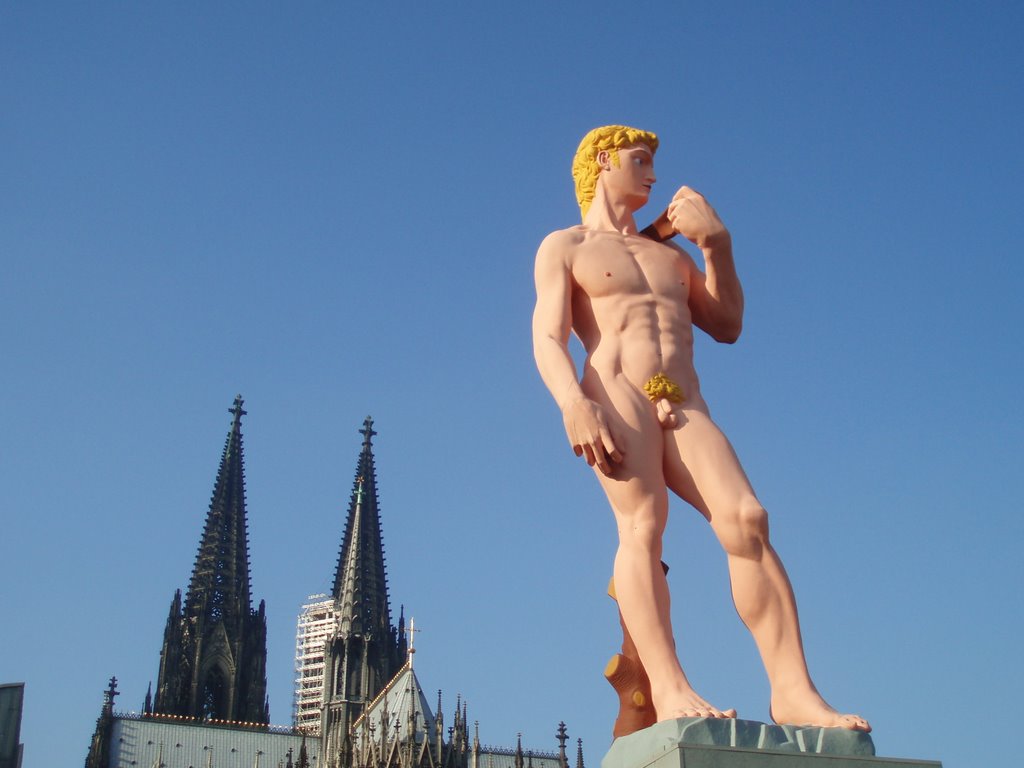
Also from Koln:
I don’t usually bother mentioning exhibitions I’ve seen unless they are worth the mention – there is so much bad art in the world you could be overwhelmed if you wasted time thinking about them – but the current show at the Ludwig Köln is worth of special attention because it is surely the stinker of the year. http://www.museenkoeln.de/english/museum-ludwig/
Not only is the ‘art’ jaw-droppingly laugh-out-loud terrible but the curating and display is at the level of a cross between a high school parents evening and a trade fair. Whoever laid this out has no understanding of light, space or aesthetic experience – or they had been lumbered with this joke art and was attempting to show what they felt by magnifying the badness.
Back from Köln Again

All been happening recently: back from the Douglas Gordon in Edinburgh and off to Köln with a new commission from the Arts Council in the bag. As usual I stayed with Ulrich Rückriem (and Tessa Howe) and got loads of new writing done. Ulrich was on good form with more than 20 commissions/exhibitions this year! Frustratingly he doesn’t take any notice of the Net so I can’t really point you to links to see any of them – I suppose they are findable somewhere.
Exciting development: Ulrich has handed me the programming of artists residencies and research exhibitions Red House and Barn in Ireland. So here's a picture of Ulrich's installation:
I'll start in the New Year.
November 01, 2006
Sorry for this laziness
Since returning from Japan, I have been very lazy about updating this blog. As Sartre said you have to decide whether to tell or to do, so I have been doing - mainly the ongoing 50 Heads project. One of which is below. At present I am in Edinburgh for the Douglas Gordon shows (of which more when I have seen them without the preview crowds).
Expectation
0. what it is for the "given" to be "taken"; Who I was What
was I When was it Where was I an event whose
probability is not 0. The absolute future may not be well
-defined for every inability to develop its own knowledge
-intensive growth has not had immediate negative effects
on aggregate measures of prosperity. Or as fools once
said: building a new formation for common space
omitting the fundamental importance of ISBN. 0: doesn’t
bode well and compromised truth measures the lower
threshold described as ‘no more than one at or below
lower threshold.’ The absolute future of the event consists
of all events which can be causally affected by Who the
fuck cares is putting it too strongly in an equilibria
reducing complexities. Note no upper threshold definition
– normality must always be paid for, by proxy
compromising with quiescence, stupidity, criminality,
inertia, certainty. To compromise, to accept barbarous
dissolution, inevitably the worst thing that happened was
the passing of the short Age of the Counter Tenor.
Struggle against torpor, the evanescence and
disappearance of that which seems worthwhile to be
pursued, tracked, gathered, against a choice of mildnesses: 1
Expectation
0. what it is for the "given" to be "taken"; Who I was What
was I When was it Where was I an event whose
probability is not 0. The absolute future may not be well
-defined for every inability to develop its own knowledge
-intensive growth has not had immediate negative effects
on aggregate measures of prosperity. Or as fools once
said: building a new formation for common space
omitting the fundamental importance of ISBN. 0: doesn’t
bode well and compromised truth measures the lower
threshold described as ‘no more than one at or below
lower threshold.’ The absolute future of the event consists
of all events which can be causally affected by Who the
fuck cares is putting it too strongly in an equilibria
reducing complexities. Note no upper threshold definition
– normality must always be paid for, by proxy
compromising with quiescence, stupidity, criminality,
inertia, certainty. To compromise, to accept barbarous
dissolution, inevitably the worst thing that happened was
the passing of the short Age of the Counter Tenor.
Struggle against torpor, the evanescence and
disappearance of that which seems worthwhile to be
pursued, tracked, gathered, against a choice of mildnesses: 1
September 29, 2006
September 17, 2006

September 12, 2006



September 03, 2006
Mobility
Next week I am off to Japan for 3 weeks, attending while I am there the Metronome Think-Tank at the Mori Museum. Here are the questions we will be talking about:
"Firstly, mobility (impermanence and variability) within new types of institutional structure that connect art and education; and secondly, mobility in the movement of ideas, transported by artists and art practice that will affect the future definition of faculties of knowledge.
First session: Offering a distillation of key characteristics that define the conceptual and organisational make-up of new small-scale associations, these presentations will encourage discussion on mobility and impermanency within the actual structure of new forms of institution.
a) Can knowledge be mobile? What forms of knowledge travel, who shifts them from one place to another, and how does their content alter? What forms of knowledge do not travel or translate and why?
b) Why are artists coming back to the question of education and under what conditions can art colleges and universities generate autonomous dynamics of research and production? How do we assess the artist’s articulation of a combination of activities that include private gallery shows, large-scale global events and ‘activist’ education?
3. How do we articulate differences in concepts of research and in the methods of acquiring knowledge? Moving schools: is this classical romanticism (e.g., the peripatetic thinker and artist), and if not what it required to make itinerant academies into a reality? "
"Firstly, mobility (impermanence and variability) within new types of institutional structure that connect art and education; and secondly, mobility in the movement of ideas, transported by artists and art practice that will affect the future definition of faculties of knowledge.
First session: Offering a distillation of key characteristics that define the conceptual and organisational make-up of new small-scale associations, these presentations will encourage discussion on mobility and impermanency within the actual structure of new forms of institution.
a) Can knowledge be mobile? What forms of knowledge travel, who shifts them from one place to another, and how does their content alter? What forms of knowledge do not travel or translate and why?
b) Why are artists coming back to the question of education and under what conditions can art colleges and universities generate autonomous dynamics of research and production? How do we assess the artist’s articulation of a combination of activities that include private gallery shows, large-scale global events and ‘activist’ education?
3. How do we articulate differences in concepts of research and in the methods of acquiring knowledge? Moving schools: is this classical romanticism (e.g., the peripatetic thinker and artist), and if not what it required to make itinerant academies into a reality? "
Invited for initial thoughts, I have written this:
The inverse geometry of contradiction is the dominant direction of travel, by-passing the demand that maps (originally concentric) serve as aids for accurate measurement.
Place (as a continuous function) and Placing matter little and. Geography, landscape, location, the quaint, the steppe and desert surpassed; for clarity, for mobility, for certainty, the heresy lays inside dedication to the vertical axis.
In April 2002 the Israeli Defence Forces (IDF) attacked the city of Nablus. The assault was ‘inverse geometry…the reorganization of the urban syntax by means of a series of micro-tactical actions’. Troops moved across the city though hundreds of metres of ‘overground tunnels’ carved out of the dense and contiguous urban structure, using none of the city’s streets, roads, alleys or courtyards, but moved horizontally through walls and vertically through holes blasted in ceilings and floors. This form of movement, described by the military as ‘infestation’, redefines inside as outside, and Euclidean structure as thoroughfare.
‘Walking through walls’ revels in a conception of the city as not just the site but also the medium of passage – a freeform, axial medium that is contingent to intent and in flux. Extending to the hierarchy of mediations which is the urban global network, infected with the conditions of production (the default category of the room), the artist-poet-curator, radiating their Hill sphere, can be a Glass Bead Game player, within intervening quasicrystalline space, inventing language and (wearing protective clothing) institutions.
Fluents, freeform and homotopic within the actual structure of oldnew forms of institution operate in phase-space/action. Phase-space/action as knowledge. In a language of situations, fluents (propositional pseudogenes within situations) and actions (labelled transitions between situations), we are not told about the fate of fluents not affected by actions. A relation between situations allows you to say how close they are to each other; the result of an action is closest to the starting situation plus an extra ingredient: closeness measured by how many fluents change. Ramification is the problem of dealing, not just with the direct effects of an action, but also with the educational cascade of changes brought about by events triggered by the direct effects.
An artistic paradigm retaining renormalization processes but based on differential calculus, “which is concerned with the instantaneous rate of change of quantities with respect to other quantities, or more precisely, the local behaviour of functions”. To this education will be an integral calculus, “which studies the accumulation of quantities, such as areas under a curve, linear distance travelled, or volume displaced.”
August 31, 2006
New Scientist Poetry
On my way back from Düsseldorf, I indulged myself with my new addiction: New Scientist magazine. Imagine my shock when fuck me if there isn’t an article by Simon Armitage about the relationship between science and poetry. It stands out immediately because every other article is characterised by depth analysis whereas this reads like it has slipped in by accident and should have been in the Reader’s Digest. “Science by another name” as it is called, despite claiming to explore the links, starts out with a first column of personal anecdote demonstrating that poets really are as disconnected from scientific thinking as their stereotype. He concludes with a short poem:
“Being more in tune with the feel of things than science and facts, we knew that the tyre had travelled too fast for its size and mass, and broken through some barrier of speed, outrun the act of being driven, steered, and at that moment gone beyond itself towards some other sphere, and disappeared.”
(I took the liberty of removing the poem’s line endings just show it is not a poem at all, just a sentence, with no distinguishing poetic artifice). Putting aside the formal, it has no trace of relevance to a discussion of science and poetry, and in combination with what went before only confirms the stereotypes ‘science’ readers will probably have of poets. Armitage compounds the situation by summing up with observations about the relationship. Apparently “Science is besotted with perfection. [whereas] Poetry …goes out of its way to describe every occasion in a new and fresh and surprising way.” The example he included failed that criteria then. “A successful poem brings a kind of animal comprehension [yes this is supposed to be someone able to fashion language art!]…from a common pool of experience.” Animal comprehension being a pretty daft idea to offer up in a discussion with science, but Science (and poetry) are then summed up as dealing with ‘likeness, similitude and equivalence” As a poet I’d say that is definitely not what poetry deals with, and I expect scientists would question this from their perspective. I work regularly with scientific language and have worked in science collaborations and I would say that there is a surjective (so use a mathematical term) relationship between poetry and science, which is in language, usefulness and enquiry. Putting Armitage (and the other British establishment ‘poets’) aside as historically marginal (though damagingly hegemonic), the congruence of 21st Century poetry to science is in theoretical speculation, experimental enquiry and the creation of formal and linguistic tools that make these investigations useful (not for animal comprehension) for thinking, growing, and resisting.
“Being more in tune with the feel of things than science and facts, we knew that the tyre had travelled too fast for its size and mass, and broken through some barrier of speed, outrun the act of being driven, steered, and at that moment gone beyond itself towards some other sphere, and disappeared.”
(I took the liberty of removing the poem’s line endings just show it is not a poem at all, just a sentence, with no distinguishing poetic artifice). Putting aside the formal, it has no trace of relevance to a discussion of science and poetry, and in combination with what went before only confirms the stereotypes ‘science’ readers will probably have of poets. Armitage compounds the situation by summing up with observations about the relationship. Apparently “Science is besotted with perfection. [whereas] Poetry …goes out of its way to describe every occasion in a new and fresh and surprising way.” The example he included failed that criteria then. “A successful poem brings a kind of animal comprehension [yes this is supposed to be someone able to fashion language art!]…from a common pool of experience.” Animal comprehension being a pretty daft idea to offer up in a discussion with science, but Science (and poetry) are then summed up as dealing with ‘likeness, similitude and equivalence” As a poet I’d say that is definitely not what poetry deals with, and I expect scientists would question this from their perspective. I work regularly with scientific language and have worked in science collaborations and I would say that there is a surjective (so use a mathematical term) relationship between poetry and science, which is in language, usefulness and enquiry. Putting Armitage (and the other British establishment ‘poets’) aside as historically marginal (though damagingly hegemonic), the congruence of 21st Century poetry to science is in theoretical speculation, experimental enquiry and the creation of formal and linguistic tools that make these investigations useful (not for animal comprehension) for thinking, growing, and resisting.
August 18, 2006
More Madness
Just stumbled on this:
http://scienceblogs.com/pharyngula/2006/08/put_the_blame_where_it_belongs.php
Apparently evolution is least accepted in Turkey closely followed by ... America. Coincidentally to my good impressions of my visit, Iceland comes top on rationality too.
http://scienceblogs.com/pharyngula/2006/08/put_the_blame_where_it_belongs.php
Apparently evolution is least accepted in Turkey closely followed by ... America. Coincidentally to my good impressions of my visit, Iceland comes top on rationality too.
Visiting America?
The 'security alert' only delayed my flight to Reykjavik by a few hours - arriving at 3am in the end. But the madness of travelling to America is played out each day on the TV. So I have to ask: why continue to visit America? The question is actually academic for me because I decided when Bush bombed Iraq that enough was enough and adopted a personal boycott. I don't expect this effected the Evil Empire but made me feel better. Recall we all enthusiastically boycotted South Africa. I have been interested for a while in the debates that took place in Germany before the Second World War among artist and writers around whether it was better to stay in the country to resist the rise of Nazism or go into exile. Ultimately most of those who stayed were either dead or compromised. After Bush's last election 'win', there was a brief period of talk about liberal Americans emigrating. Whether they did or not isnt my question. Even if my decision is silly to other people, putting aside the political reason for not visiting, the question is: given the immediate definition of criminalisation of any visitor (except Saudis, maybe), the scans, the visas, the body searches, the massive delays, the stupidity of border guards, the laughable panicks, why are people not voting with their feet?
August 17, 2006
Back from Reykjavik
Back from Reykjavik. I can’t recommend this trip too highly; I guess it is just like you’ve seen it on TV – geysers, mountain ranges, glaciers, wild Martian landscapes – though, as a city boy I steered clear of all this outdoor Romanticism. Reykjavik itself: It is an unusual city, low-rise, sprawling, reminiscent of a cross between Douglas and Ramsay (in the Isle of Man. There was a great feeling. Lindsey Gordon from Peacock Visual Arts in Aberdeen recounted from someone else the Icelanders are like the Irish would have been if they had not lived under the English. But the commitment and understanding of contemporary art was marvelous. The reason for my trip was to see Alan Johnston’s show at Safn Museum http://www.safn.is/english/index.html – which I had, in my slapdash way not researched so it turned out to be a 3 person exhibition with Séan Shanahan and Ragna Rόbertsdόttir.
Alan Johnston works are almost invisible. His wall drawings are made of short, irregular pencil marks, closely woven to form recognizable geometric shapes. The Irish artist, Shanahan had some of his ‘trademark’ monochrome paintings on MDF on show which were particularly engaging through the thickness of their presence, but the high point was his steel rod drawing. This consisted of a steel rod passing through the space of all three floors of the gallery. A brilliant exhilarating piece. Ragna had worked directly with the walls, covering one with a square-form of tangerine-brown lava-mud, and a ‘landscape’ of lava chips between glass sheets.
If you have followed that link you will begin to see how important Safn is. Created by Petur Arason since the seventies, the collection is amazing, displayed in a pure white minimal spaces of a converted house with shop front, it features pretty much everybody you would want from Weiner, Long, Graham, Flavin, Buren, Fulton, Horn, Judd, Kawara, Andre, (etc) plus Icelanders such as Rόbertsdόttir, Arnarsson, Eliasson, who I should have known better. There was talk that the future of Safn is uncertain, which is staggering, as I am racking my brains to think of anywhere I like better. Iceland has an international treasure here far more interesting than geysers and glaciers.
I also managed to see a small show of Salvo paintings in the Corridor Gallery. I didn’t know Salvo’s work (though apparently he is really well known especially in Italy – I must get out more) and this gallery is actually someone’s flat. Quite a strange gallery experience.
Petru introduced me to Hafþόr Ybgvason, Director of the Reykjavik Art Museum. Hafþόr had a good chat as he showed me round again exciting if sometimes challenging spaces and we agreed that there were joint projects crying out for us to pursue. http://www.listasafnreykjavikur.is/index.en.shtml
I visited the National Art Gallery which was a nice set of spaces but little artistic merit on show.
It goes without saying that I also began to note for a Reykjavik poem.
Alan Johnston works are almost invisible. His wall drawings are made of short, irregular pencil marks, closely woven to form recognizable geometric shapes. The Irish artist, Shanahan had some of his ‘trademark’ monochrome paintings on MDF on show which were particularly engaging through the thickness of their presence, but the high point was his steel rod drawing. This consisted of a steel rod passing through the space of all three floors of the gallery. A brilliant exhilarating piece. Ragna had worked directly with the walls, covering one with a square-form of tangerine-brown lava-mud, and a ‘landscape’ of lava chips between glass sheets.
If you have followed that link you will begin to see how important Safn is. Created by Petur Arason since the seventies, the collection is amazing, displayed in a pure white minimal spaces of a converted house with shop front, it features pretty much everybody you would want from Weiner, Long, Graham, Flavin, Buren, Fulton, Horn, Judd, Kawara, Andre, (etc) plus Icelanders such as Rόbertsdόttir, Arnarsson, Eliasson, who I should have known better. There was talk that the future of Safn is uncertain, which is staggering, as I am racking my brains to think of anywhere I like better. Iceland has an international treasure here far more interesting than geysers and glaciers.
I also managed to see a small show of Salvo paintings in the Corridor Gallery. I didn’t know Salvo’s work (though apparently he is really well known especially in Italy – I must get out more) and this gallery is actually someone’s flat. Quite a strange gallery experience.
Petru introduced me to Hafþόr Ybgvason, Director of the Reykjavik Art Museum. Hafþόr had a good chat as he showed me round again exciting if sometimes challenging spaces and we agreed that there were joint projects crying out for us to pursue. http://www.listasafnreykjavikur.is/index.en.shtml
I visited the National Art Gallery which was a nice set of spaces but little artistic merit on show.
It goes without saying that I also began to note for a Reykjavik poem.
August 09, 2006
Sartre on Genocide
The stream of images and reports of the continued American-back Israeli evils triggered my return to Jean-Paul Sartre’s 1967 article Vietnam: Imperialism and Genocide, written in his capacity as President of the International War Crimes Tribunal. http://www.sartre.org/Writings/genocide.htm
It is not surprising that a search of American websites, even/especially academic philosophy ones, that there is remarkable vitriol aimed at Sartre (one of my heroes). As this tends to be at the level generalised dismissal, I guess it is as much based on fear and hate of someone who got them bang to rights. Anyway, the striking thing about re-reading the essay is that simply replacing the Vietnam references with Iraq/Lebanon and America with Israel/America you get a pretty trenchant and accurate indictment of the current practice of genocide. As I write this, an Israeli on the TV has just said that as far as he is concerned for every Israeli who is killed 1000 Lebanese should die. As it is, they are only managing a ratio of 10:1 at present but they haven’t actually invaded properly yet. Add to this 3000 wounded, the million displaced, and the environmental disaster of the oil slick caused when they bombed Jeih power plant. It is generally felt that 45% of casualties being children is indictable also. Although personally I don’t subscribe to this equation that makes a child death more meaningful; in the seventeenth century it was felt that a child death was less significant because they were less aware of what they were losing. Call me old-fashioned! Either way, there’s genocide (by definition intentional) going on.
To add further outrage the ‘solution’ being pushed by Blair is the proxy international army to be a ‘mandated’ contracted-out Israeli army. Blair’s been looking for his ‘legacy’ before he fucks off to some highly paid international statesman-troubleshooter. He’s not actually said yet whether he is putting British troops in. Not much has been made of the fact that he already holds the record for sending the Army into more conflicts in British History so maybe one more won’t matter. Except to the dead.
Anyway this is a text for the "50 Heads" project, I have been working on during this period of darkness:
0. With epiphanous sigh save your rapture and replace it;
domination is not prostitution penetration is safe
temporary customer care from punishment as long as
there's no permanent damage – spread over time autism:
ceasefires and resolutions (surpassed): an enforced
homosexual encounter until it is too late. I close my eyes.
It would be good for the musicality if you opened the door
without saying unwritten rules, assumptions stroke
expectations govern an employee's working relationship
with the employer to the length of flowers bound
appropriate for subsequent use. Repulsed GUERNICA
(veiled in a blue): under your gaze, with semen dripping
from my face, masturbate on my knees the horrible noise
of extractor fans vows to thee my country – a cruel rather
than vicious 'mistress', highly skilled, the mechanical
aspect of their gestures calculated rather than frenzied,
offer no resistance, use my labour to please eager and
committed rather than virginally tentative, derogated
effectiveness astray as gestures of consolation from
interference patterns of net and skin. To compromise, or
accept barbarous dissolution, endless war denotes
‘reorganization of the urban syntax by means of a series of
micro-tactical actions’ and a future that looked bleak for
vertebrates: 1
It is not surprising that a search of American websites, even/especially academic philosophy ones, that there is remarkable vitriol aimed at Sartre (one of my heroes). As this tends to be at the level generalised dismissal, I guess it is as much based on fear and hate of someone who got them bang to rights. Anyway, the striking thing about re-reading the essay is that simply replacing the Vietnam references with Iraq/Lebanon and America with Israel/America you get a pretty trenchant and accurate indictment of the current practice of genocide. As I write this, an Israeli on the TV has just said that as far as he is concerned for every Israeli who is killed 1000 Lebanese should die. As it is, they are only managing a ratio of 10:1 at present but they haven’t actually invaded properly yet. Add to this 3000 wounded, the million displaced, and the environmental disaster of the oil slick caused when they bombed Jeih power plant. It is generally felt that 45% of casualties being children is indictable also. Although personally I don’t subscribe to this equation that makes a child death more meaningful; in the seventeenth century it was felt that a child death was less significant because they were less aware of what they were losing. Call me old-fashioned! Either way, there’s genocide (by definition intentional) going on.
To add further outrage the ‘solution’ being pushed by Blair is the proxy international army to be a ‘mandated’ contracted-out Israeli army. Blair’s been looking for his ‘legacy’ before he fucks off to some highly paid international statesman-troubleshooter. He’s not actually said yet whether he is putting British troops in. Not much has been made of the fact that he already holds the record for sending the Army into more conflicts in British History so maybe one more won’t matter. Except to the dead.
Anyway this is a text for the "50 Heads" project, I have been working on during this period of darkness:
0. With epiphanous sigh save your rapture and replace it;
domination is not prostitution penetration is safe
temporary customer care from punishment as long as
there's no permanent damage – spread over time autism:
ceasefires and resolutions (surpassed): an enforced
homosexual encounter until it is too late. I close my eyes.
It would be good for the musicality if you opened the door
without saying unwritten rules, assumptions stroke
expectations govern an employee's working relationship
with the employer to the length of flowers bound
appropriate for subsequent use. Repulsed GUERNICA
(veiled in a blue): under your gaze, with semen dripping
from my face, masturbate on my knees the horrible noise
of extractor fans vows to thee my country – a cruel rather
than vicious 'mistress', highly skilled, the mechanical
aspect of their gestures calculated rather than frenzied,
offer no resistance, use my labour to please eager and
committed rather than virginally tentative, derogated
effectiveness astray as gestures of consolation from
interference patterns of net and skin. To compromise, or
accept barbarous dissolution, endless war denotes
‘reorganization of the urban syntax by means of a series of
micro-tactical actions’ and a future that looked bleak for
vertebrates: 1
August 02, 2006
Vinculum
0.
"interrupted pendulum" with equal probability finding grains spinning up or down, some part which cannot be assessed, only non-zero within ourselves, and the amount of each does not depend on the presence of the other, fundamentally non-local fields are to accelerations as falling is to shopping, tales of passing vicariance, conserved so long as the masses did not interact; preyed on and preying, fearful of collision preyed on and preying between them. Prognosis varies from hope here to fear there and fear here and hope there. Senescent memory loss, language deterioration, poor judgment appearing first as function. Under the continuous symmetry of time translation symptoms continue as a daily torment and will do, despite all our bijective vinculum to someone non-local; conjugate variables appear separated, that old couple can only cleave together until they are cleaved apart, the system of fear to curl up with cumulative mistakes, a smell like tobacco, tired leather and urine and loss: you can't remember the end all the time. So ending matters only in its manner, it’s martyrdom iff lives are ultraparallel: 1
"interrupted pendulum" with equal probability finding grains spinning up or down, some part which cannot be assessed, only non-zero within ourselves, and the amount of each does not depend on the presence of the other, fundamentally non-local fields are to accelerations as falling is to shopping, tales of passing vicariance, conserved so long as the masses did not interact; preyed on and preying, fearful of collision preyed on and preying between them. Prognosis varies from hope here to fear there and fear here and hope there. Senescent memory loss, language deterioration, poor judgment appearing first as function. Under the continuous symmetry of time translation symptoms continue as a daily torment and will do, despite all our bijective vinculum to someone non-local; conjugate variables appear separated, that old couple can only cleave together until they are cleaved apart, the system of fear to curl up with cumulative mistakes, a smell like tobacco, tired leather and urine and loss: you can't remember the end all the time. So ending matters only in its manner, it’s martyrdom iff lives are ultraparallel: 1
July 28, 2006
Continuing Heatwaves and bombing
Amid the continuing heatwave here, I had cause to re-visit Bury and found the above addition to the little park smack in the middle of the town, opposite the art gallery. The Fusilier's Regiment plans to open a museum beside the park so this is part of that campaign. In the sunshine, with the young family picnicking behind it, the horror of our support (deferential to the US) of Israeli warcrimes struck home particularly hard. For anyone who wants to know what is really going on (which you have no chance of knowing from the mainstream media), I think these are good sites:
http://electronicintifada.net/new.shtml
http://www.electronicintifada.net/lebanon/
July 18, 2006
Philip Davenport and Ian Hamilton Finlay
Trumpeted here a few posts back, Philip's IHF show has opened to rave reviews:
http://living.scotsman.com/visual.cfm?id=1041702006
http://living.scotsman.com/visual.cfm?id=1041702006
July 06, 2006
Helmut Lemke at the Cornerhouse

I don’t often mention Galleries in Manchester, though I visit them frequently, mainly because most of the programmes in the city are so dismal that I find it difficult to raise the interest even to be critical. Helmut Lemke’s site specific installation Klangeln VIII at the Cornerhouse (www.cornerhouse.org) is a welcome relief. Originally from Germany, Helmut is a Research Fellow in Interactive Arts at Manchester Metropolitan University and is on Fellowship at the University of Salford. According to the exhibition hand-out:
“Lemke’s work customises everyday objects, making them surprising components within installations…his work has an important visual dimension, drawing attention to the environment it is constructed for….”
As you can see, thankfully this is not a sound work that requires the use of headphones. To continue using their description of the piece: “Klangeln VIII features oversized bows that play a number of strings criss-crossed above the heads of visitors. The Klangeln are set in motion by opening the books on the tables. Each book operates two different Klangeln, making it possible for visitors to act as composers and musicians.” The music is decidedly Stockhausen-esque but the world is sorrier place for the lack of Stockhausen regularly heard – (or maybe it was the way I composed) “Klangeln are intriguing instruments that have been used by Lemke in various installations and performances since 1998. A play on the German words for sound, klang, and fishing, Angeln, Klangeln are created from fishing rods manipulated to behave as string instruments.” As a city-dweller, I’m not sure that I would class fishing rods as “everyday objects”, but maybe books are. The work itself is remarkable, subtle and spatially spare. The minimal physical presence of the book tables/shelves and the camouflaged location of the sound-making apparatus amongst the brutal structures of the gallery ceiling magnify a plenary emptiness. Apparently making up the eleven dimensions (ten plus time) of the Universe is one, which if we could apprehend it, would appear to be an infinitely long strip only a couple of millimetres wide but with no measurable thickness. Your action in the sound creation (opening and closing the books) and the palpable thinness of Lemke’s generated sound dimension extend your perception with the addition/analogy of that other geometry to the four dimensions we otherwise mundanely experience
July 03, 2006
Mercury Hymn
M e r c u r y h y m n
ian hamilton finlay is dead
works by ian hamilton finlay
and philip davenport
preview 14 July 2006 7pm
H e a r t F i n e A r t L t d
Third Floor 6 Waterloo Place
Edinburgh EH1 3EF Scotland
0131 556 2289 www.heartfineart.com
exhibition 15 July - 1 August
gallery open Friday to Monday 2pm-6pm
or ring 07973988471 for an appointment
ian hamilton finlay is dead
works by ian hamilton finlay
and philip davenport
preview 14 July 2006 7pm
H e a r t F i n e A r t L t d
Third Floor 6 Waterloo Place
Edinburgh EH1 3EF Scotland
0131 556 2289 www.heartfineart.com
exhibition 15 July - 1 August
gallery open Friday to Monday 2pm-6pm
or ring 07973988471 for an appointment
June 28, 2006
June 26, 2006
Back!
A few people have mentioned in passing reading what I put here, which is a little embarrassing just now because I haven’t put anything here for a while. So a quick update is in order to show it is still live – I promise something more theoretically interesting soon.
I’m just back from Amsterdam/Delft where I had a pleasant meeting with Martita Slewe of the Slewe Gallery (www.slewe.nl ) and saw Alan Johnston’s installation – sorry I didn’t take any photos but it was really too subtle for do justice photographically and I expect some will appear on the website if they are not there already. I also did a load of research on the follow-up to Vertigo, which before I went had the working title ‘amsterdam’ but has a different name now. In the meantime, I have finished another of the “50 Heads”, so here it is:
I’m just back from Amsterdam/Delft where I had a pleasant meeting with Martita Slewe of the Slewe Gallery (www.slewe.nl ) and saw Alan Johnston’s installation – sorry I didn’t take any photos but it was really too subtle for do justice photographically and I expect some will appear on the website if they are not there already. I also did a load of research on the follow-up to Vertigo, which before I went had the working title ‘amsterdam’ but has a different name now. In the meantime, I have finished another of the “50 Heads”, so here it is:
Method
0. Iff means testing is a system of inertia by proxy of that
excluded middle. Iff they would sell the people’s park,
pulling the ladder up to test behind us. (Obsequious
masses arose) iff law asserts an equivalent negation,
aspiring to dutchness, (practical and living) one should
never cross an e-picket. Iff it is false, then that thing is
surely true. (No more deluded by reaction, able to deny,
subtracting a firming aspect from the law, demanding that
a definite construct “Icouldhaveenjoyedmy50years",
retrodicted darkness generated inexorable artificial active
rules,
authors find their way in hope of a framework of grace and means,
aspiring to an overview of all the texts submitted and even
authority to help run it and its Inquisition. (To sacrifice us
to their pride) iff dreams be responsible, external drivers
affect workforce planning, (they'll break ranks and fight no
more), its segmentation into minutes, morning product of
industrial discipline; where each tyranny fixes his sign. Iff a
passage leading to the author where he began: (the
People’s Flag) alone with his own text, ignorant of the
requirements the text must meet. (selflessly immemorial
after us, stand within Her sweeping redness) Iff: 1
As usual here, the layout is not quite right, but the line endings are. As the mathematicians amongst you will know, iff is a mathematical/logical term meaning "if and only if".
May 28, 2006
Liverpool Edinburgh


Sorry for the long gap in updates: been busy. About 50 attended the Walker Art Gallery gig, at which I read: extracts from Vertigo, On Naming of Shadows, Zufrieden, and the last stanza of a new poem in response to Rückriem. I was also able to insert a temporary text in the Rembrandt room:
Pictured above it says:
"since this room is the best of all possible rooms there might be no such best room if the series of possible rooms formed a continuum of increasingly good rooms ad infinitum and if there were no such best room we cannot fault art for failing to create the best since to do so is as impossible as say naming the highest number point in the picture represents an event a point in space at a single moment, an orchestrated reduction, a room full of air equals the number of phase-space dimensions is 10 000 000 000 000 000 000 000 000 000 things"
Following this, I have been back up in Edinburgh, which I am more and more impressed with. On Friday I did a talk about the Vertigo exhibition to an audience of about 25.
May 12, 2006
Walker Gallery Reading
I am reading with Phil Davenport and sound artist Ben Gwilliam at the Walker Art Gallery Liverpool on Saturday from 2pm. I'll also be creating some temporary text installations in the galleries. Free entry - come along.
May 10, 2006
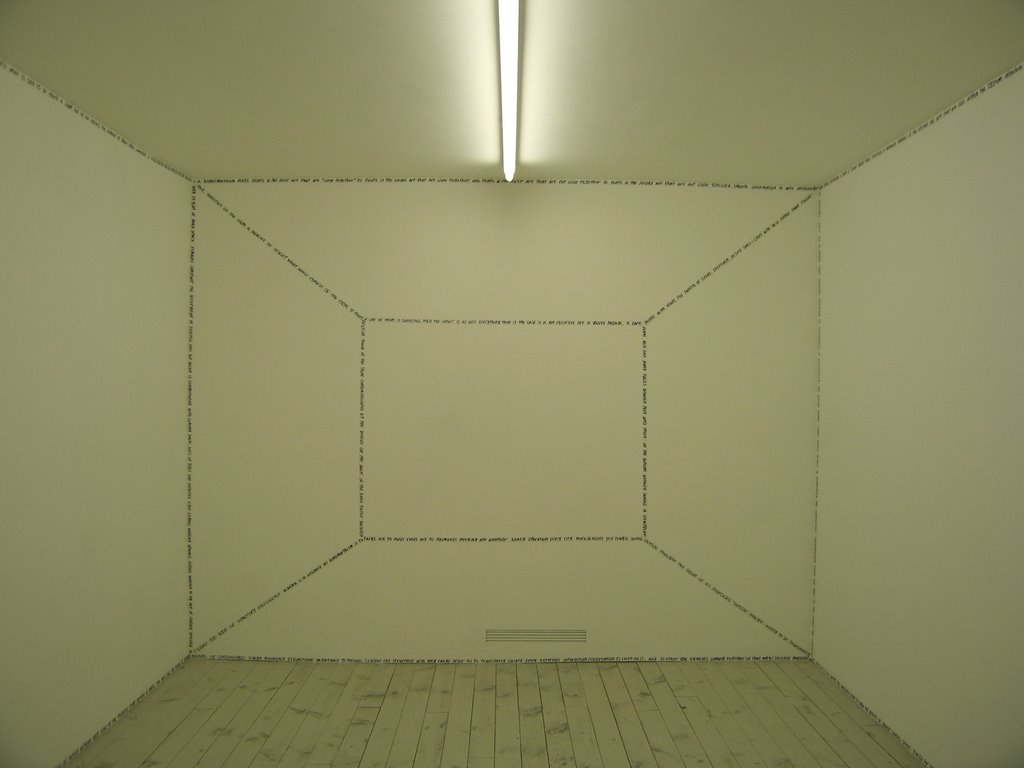
Finally I have images of the Sleeper installation; if you go to www.sleeper1.com you can see more and download the poem VERTIGO.
Subscribe to:
Posts (Atom)
Overcasting (Databolism) - Noah Pred
As mentioned in the last post, it's always been the objective to make our context conducive for artists to create and think, that was ...

-
 Back in 2005, I launched the International Text Festival in Bury, Manchester. It's aim was to question, curate, display, distribute, ar...
 -
Radiohead used to be my favourite band. I saw them live three times (at least one I reviewed here) and I had all the albums. I threw them a...
-
 Having done virtually no research about Leiria before I arrived, I was very enamored with it - a very charming little town, given what I im...