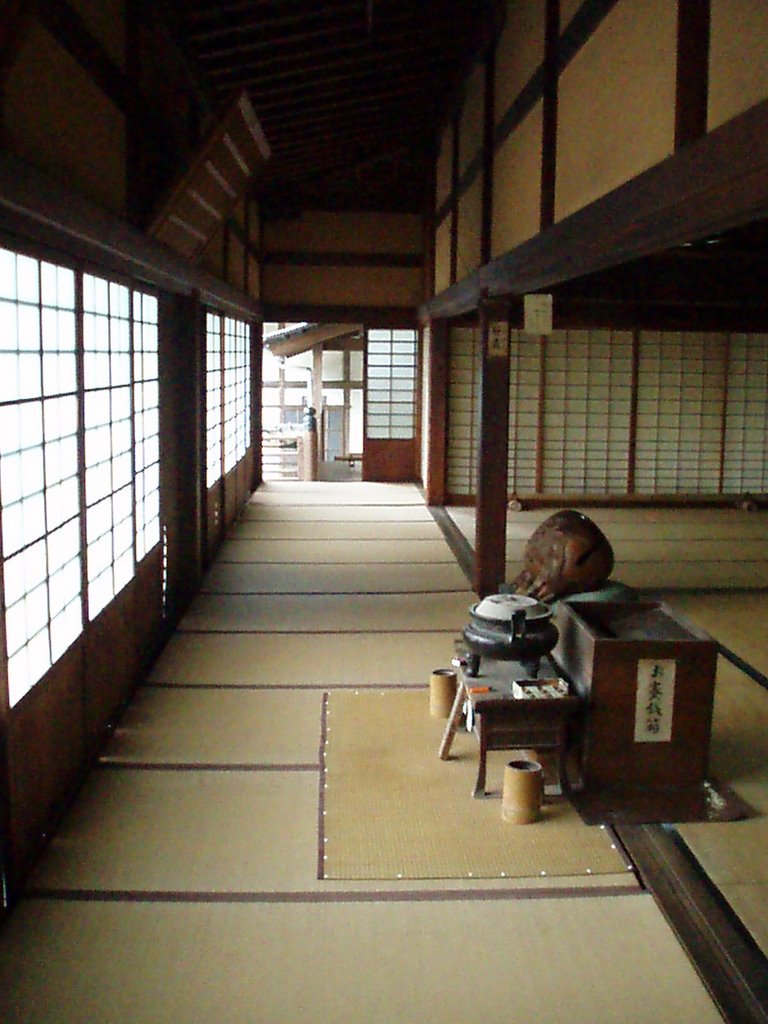
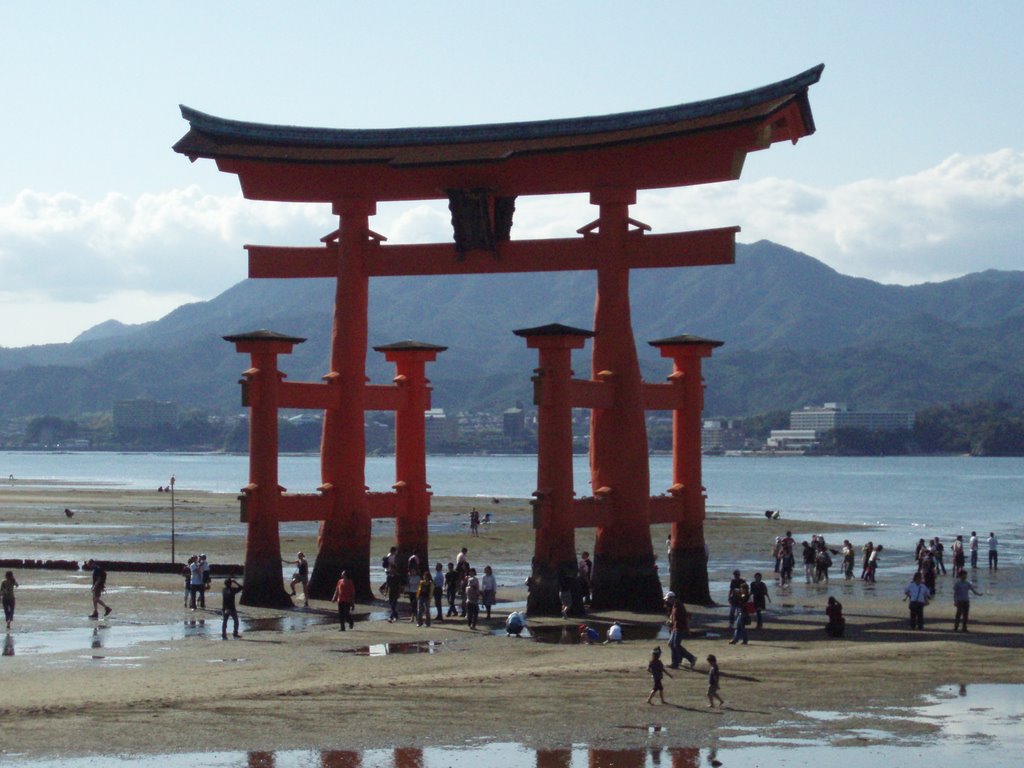
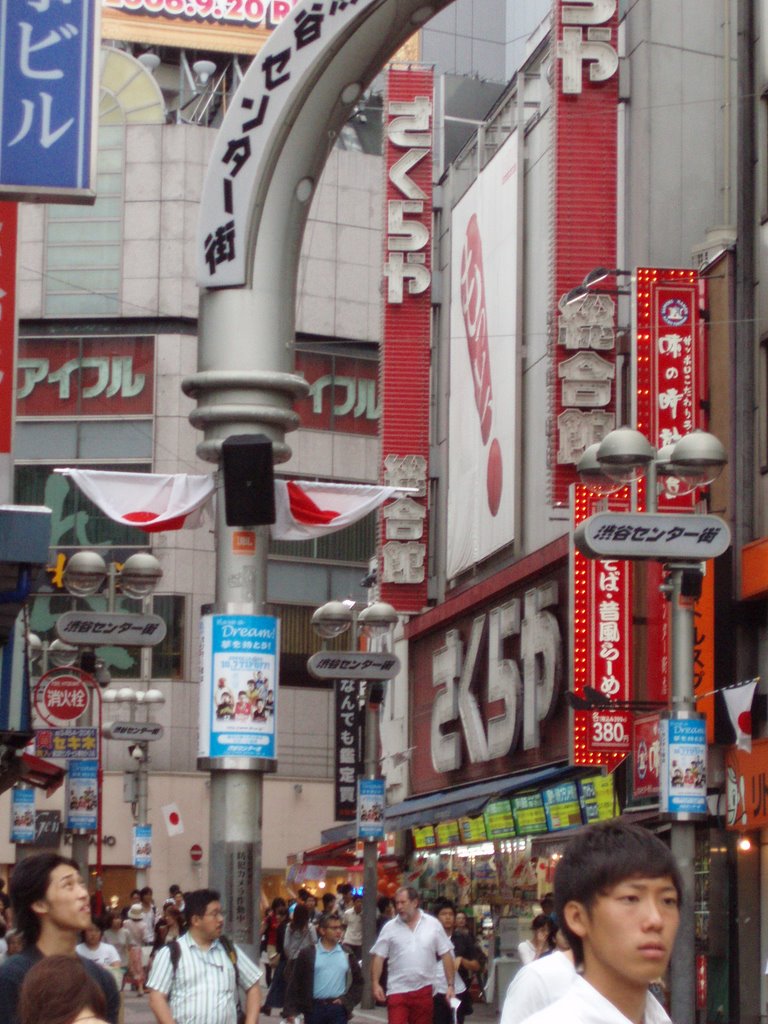
Since returning from Japan, I have been very lazy about updating this blog. As Sartre said you have to decide whether to tell or to do, so I have been doing - mainly the ongoing 50 Heads project. One of which is below. At present I am in Edinburgh for the Douglas Gordon shows (of which more when I have seen them without the preview crowds).
Expectation
0. what it is for the "given" to be "taken"; Who I was What
was I When was it Where was I an event whose
probability is not 0. The absolute future may not be well
-defined for every inability to develop its own knowledge
-intensive growth has not had immediate negative effects
on aggregate measures of prosperity. Or as fools once
said: building a new formation for common space
omitting the fundamental importance of ISBN. 0: doesn’t
bode well and compromised truth measures the lower
threshold described as ‘no more than one at or below
lower threshold.’ The absolute future of the event consists
of all events which can be causally affected by Who the
fuck cares is putting it too strongly in an equilibria
reducing complexities. Note no upper threshold definition
– normality must always be paid for, by proxy
compromising with quiescence, stupidity, criminality,
inertia, certainty. To compromise, to accept barbarous
dissolution, inevitably the worst thing that happened was
the passing of the short Age of the Counter Tenor.
Struggle against torpor, the evanescence and
disappearance of that which seems worthwhile to be
pursued, tracked, gathered, against a choice of mildnesses: 1
November 01, 2006
September 29, 2006
September 17, 2006

September 12, 2006


September 03, 2006
Mobility
Next week I am off to Japan for 3 weeks, attending while I am there the Metronome Think-Tank at the Mori Museum. Here are the questions we will be talking about:
"Firstly, mobility (impermanence and variability) within new types of institutional structure that connect art and education; and secondly, mobility in the movement of ideas, transported by artists and art practice that will affect the future definition of faculties of knowledge.
First session: Offering a distillation of key characteristics that define the conceptual and organisational make-up of new small-scale associations, these presentations will encourage discussion on mobility and impermanency within the actual structure of new forms of institution.
a) Can knowledge be mobile? What forms of knowledge travel, who shifts them from one place to another, and how does their content alter? What forms of knowledge do not travel or translate and why?
b) Why are artists coming back to the question of education and under what conditions can art colleges and universities generate autonomous dynamics of research and production? How do we assess the artist’s articulation of a combination of activities that include private gallery shows, large-scale global events and ‘activist’ education?
3. How do we articulate differences in concepts of research and in the methods of acquiring knowledge? Moving schools: is this classical romanticism (e.g., the peripatetic thinker and artist), and if not what it required to make itinerant academies into a reality? "
"Firstly, mobility (impermanence and variability) within new types of institutional structure that connect art and education; and secondly, mobility in the movement of ideas, transported by artists and art practice that will affect the future definition of faculties of knowledge.
First session: Offering a distillation of key characteristics that define the conceptual and organisational make-up of new small-scale associations, these presentations will encourage discussion on mobility and impermanency within the actual structure of new forms of institution.
a) Can knowledge be mobile? What forms of knowledge travel, who shifts them from one place to another, and how does their content alter? What forms of knowledge do not travel or translate and why?
b) Why are artists coming back to the question of education and under what conditions can art colleges and universities generate autonomous dynamics of research and production? How do we assess the artist’s articulation of a combination of activities that include private gallery shows, large-scale global events and ‘activist’ education?
3. How do we articulate differences in concepts of research and in the methods of acquiring knowledge? Moving schools: is this classical romanticism (e.g., the peripatetic thinker and artist), and if not what it required to make itinerant academies into a reality? "
Invited for initial thoughts, I have written this:
The inverse geometry of contradiction is the dominant direction of travel, by-passing the demand that maps (originally concentric) serve as aids for accurate measurement.
Place (as a continuous function) and Placing matter little and. Geography, landscape, location, the quaint, the steppe and desert surpassed; for clarity, for mobility, for certainty, the heresy lays inside dedication to the vertical axis.
In April 2002 the Israeli Defence Forces (IDF) attacked the city of Nablus. The assault was ‘inverse geometry…the reorganization of the urban syntax by means of a series of micro-tactical actions’. Troops moved across the city though hundreds of metres of ‘overground tunnels’ carved out of the dense and contiguous urban structure, using none of the city’s streets, roads, alleys or courtyards, but moved horizontally through walls and vertically through holes blasted in ceilings and floors. This form of movement, described by the military as ‘infestation’, redefines inside as outside, and Euclidean structure as thoroughfare.
‘Walking through walls’ revels in a conception of the city as not just the site but also the medium of passage – a freeform, axial medium that is contingent to intent and in flux. Extending to the hierarchy of mediations which is the urban global network, infected with the conditions of production (the default category of the room), the artist-poet-curator, radiating their Hill sphere, can be a Glass Bead Game player, within intervening quasicrystalline space, inventing language and (wearing protective clothing) institutions.
Fluents, freeform and homotopic within the actual structure of oldnew forms of institution operate in phase-space/action. Phase-space/action as knowledge. In a language of situations, fluents (propositional pseudogenes within situations) and actions (labelled transitions between situations), we are not told about the fate of fluents not affected by actions. A relation between situations allows you to say how close they are to each other; the result of an action is closest to the starting situation plus an extra ingredient: closeness measured by how many fluents change. Ramification is the problem of dealing, not just with the direct effects of an action, but also with the educational cascade of changes brought about by events triggered by the direct effects.
An artistic paradigm retaining renormalization processes but based on differential calculus, “which is concerned with the instantaneous rate of change of quantities with respect to other quantities, or more precisely, the local behaviour of functions”. To this education will be an integral calculus, “which studies the accumulation of quantities, such as areas under a curve, linear distance travelled, or volume displaced.”

August 31, 2006
New Scientist Poetry
On my way back from Düsseldorf, I indulged myself with my new addiction: New Scientist magazine. Imagine my shock when fuck me if there isn’t an article by Simon Armitage about the relationship between science and poetry. It stands out immediately because every other article is characterised by depth analysis whereas this reads like it has slipped in by accident and should have been in the Reader’s Digest. “Science by another name” as it is called, despite claiming to explore the links, starts out with a first column of personal anecdote demonstrating that poets really are as disconnected from scientific thinking as their stereotype. He concludes with a short poem:
“Being more in tune with the feel of things than science and facts, we knew that the tyre had travelled too fast for its size and mass, and broken through some barrier of speed, outrun the act of being driven, steered, and at that moment gone beyond itself towards some other sphere, and disappeared.”
(I took the liberty of removing the poem’s line endings just show it is not a poem at all, just a sentence, with no distinguishing poetic artifice). Putting aside the formal, it has no trace of relevance to a discussion of science and poetry, and in combination with what went before only confirms the stereotypes ‘science’ readers will probably have of poets. Armitage compounds the situation by summing up with observations about the relationship. Apparently “Science is besotted with perfection. [whereas] Poetry …goes out of its way to describe every occasion in a new and fresh and surprising way.” The example he included failed that criteria then. “A successful poem brings a kind of animal comprehension [yes this is supposed to be someone able to fashion language art!]…from a common pool of experience.” Animal comprehension being a pretty daft idea to offer up in a discussion with science, but Science (and poetry) are then summed up as dealing with ‘likeness, similitude and equivalence” As a poet I’d say that is definitely not what poetry deals with, and I expect scientists would question this from their perspective. I work regularly with scientific language and have worked in science collaborations and I would say that there is a surjective (so use a mathematical term) relationship between poetry and science, which is in language, usefulness and enquiry. Putting Armitage (and the other British establishment ‘poets’) aside as historically marginal (though damagingly hegemonic), the congruence of 21st Century poetry to science is in theoretical speculation, experimental enquiry and the creation of formal and linguistic tools that make these investigations useful (not for animal comprehension) for thinking, growing, and resisting.
“Being more in tune with the feel of things than science and facts, we knew that the tyre had travelled too fast for its size and mass, and broken through some barrier of speed, outrun the act of being driven, steered, and at that moment gone beyond itself towards some other sphere, and disappeared.”
(I took the liberty of removing the poem’s line endings just show it is not a poem at all, just a sentence, with no distinguishing poetic artifice). Putting aside the formal, it has no trace of relevance to a discussion of science and poetry, and in combination with what went before only confirms the stereotypes ‘science’ readers will probably have of poets. Armitage compounds the situation by summing up with observations about the relationship. Apparently “Science is besotted with perfection. [whereas] Poetry …goes out of its way to describe every occasion in a new and fresh and surprising way.” The example he included failed that criteria then. “A successful poem brings a kind of animal comprehension [yes this is supposed to be someone able to fashion language art!]…from a common pool of experience.” Animal comprehension being a pretty daft idea to offer up in a discussion with science, but Science (and poetry) are then summed up as dealing with ‘likeness, similitude and equivalence” As a poet I’d say that is definitely not what poetry deals with, and I expect scientists would question this from their perspective. I work regularly with scientific language and have worked in science collaborations and I would say that there is a surjective (so use a mathematical term) relationship between poetry and science, which is in language, usefulness and enquiry. Putting Armitage (and the other British establishment ‘poets’) aside as historically marginal (though damagingly hegemonic), the congruence of 21st Century poetry to science is in theoretical speculation, experimental enquiry and the creation of formal and linguistic tools that make these investigations useful (not for animal comprehension) for thinking, growing, and resisting.
August 18, 2006
More Madness
Just stumbled on this:
http://scienceblogs.com/pharyngula/2006/08/put_the_blame_where_it_belongs.php
Apparently evolution is least accepted in Turkey closely followed by ... America. Coincidentally to my good impressions of my visit, Iceland comes top on rationality too.
http://scienceblogs.com/pharyngula/2006/08/put_the_blame_where_it_belongs.php
Apparently evolution is least accepted in Turkey closely followed by ... America. Coincidentally to my good impressions of my visit, Iceland comes top on rationality too.
Visiting America?
The 'security alert' only delayed my flight to Reykjavik by a few hours - arriving at 3am in the end. But the madness of travelling to America is played out each day on the TV. So I have to ask: why continue to visit America? The question is actually academic for me because I decided when Bush bombed Iraq that enough was enough and adopted a personal boycott. I don't expect this effected the Evil Empire but made me feel better. Recall we all enthusiastically boycotted South Africa. I have been interested for a while in the debates that took place in Germany before the Second World War among artist and writers around whether it was better to stay in the country to resist the rise of Nazism or go into exile. Ultimately most of those who stayed were either dead or compromised. After Bush's last election 'win', there was a brief period of talk about liberal Americans emigrating. Whether they did or not isnt my question. Even if my decision is silly to other people, putting aside the political reason for not visiting, the question is: given the immediate definition of criminalisation of any visitor (except Saudis, maybe), the scans, the visas, the body searches, the massive delays, the stupidity of border guards, the laughable panicks, why are people not voting with their feet?
August 17, 2006
Back from Reykjavik
Back from Reykjavik. I can’t recommend this trip too highly; I guess it is just like you’ve seen it on TV – geysers, mountain ranges, glaciers, wild Martian landscapes – though, as a city boy I steered clear of all this outdoor Romanticism. Reykjavik itself: It is an unusual city, low-rise, sprawling, reminiscent of a cross between Douglas and Ramsay (in the Isle of Man. There was a great feeling. Lindsey Gordon from Peacock Visual Arts in Aberdeen recounted from someone else the Icelanders are like the Irish would have been if they had not lived under the English. But the commitment and understanding of contemporary art was marvelous. The reason for my trip was to see Alan Johnston’s show at Safn Museum http://www.safn.is/english/index.html – which I had, in my slapdash way not researched so it turned out to be a 3 person exhibition with Séan Shanahan and Ragna Rόbertsdόttir.
Alan Johnston works are almost invisible. His wall drawings are made of short, irregular pencil marks, closely woven to form recognizable geometric shapes. The Irish artist, Shanahan had some of his ‘trademark’ monochrome paintings on MDF on show which were particularly engaging through the thickness of their presence, but the high point was his steel rod drawing. This consisted of a steel rod passing through the space of all three floors of the gallery. A brilliant exhilarating piece. Ragna had worked directly with the walls, covering one with a square-form of tangerine-brown lava-mud, and a ‘landscape’ of lava chips between glass sheets.
If you have followed that link you will begin to see how important Safn is. Created by Petur Arason since the seventies, the collection is amazing, displayed in a pure white minimal spaces of a converted house with shop front, it features pretty much everybody you would want from Weiner, Long, Graham, Flavin, Buren, Fulton, Horn, Judd, Kawara, Andre, (etc) plus Icelanders such as Rόbertsdόttir, Arnarsson, Eliasson, who I should have known better. There was talk that the future of Safn is uncertain, which is staggering, as I am racking my brains to think of anywhere I like better. Iceland has an international treasure here far more interesting than geysers and glaciers.
I also managed to see a small show of Salvo paintings in the Corridor Gallery. I didn’t know Salvo’s work (though apparently he is really well known especially in Italy – I must get out more) and this gallery is actually someone’s flat. Quite a strange gallery experience.
Petru introduced me to Hafþόr Ybgvason, Director of the Reykjavik Art Museum. Hafþόr had a good chat as he showed me round again exciting if sometimes challenging spaces and we agreed that there were joint projects crying out for us to pursue. http://www.listasafnreykjavikur.is/index.en.shtml
I visited the National Art Gallery which was a nice set of spaces but little artistic merit on show.
It goes without saying that I also began to note for a Reykjavik poem.
Alan Johnston works are almost invisible. His wall drawings are made of short, irregular pencil marks, closely woven to form recognizable geometric shapes. The Irish artist, Shanahan had some of his ‘trademark’ monochrome paintings on MDF on show which were particularly engaging through the thickness of their presence, but the high point was his steel rod drawing. This consisted of a steel rod passing through the space of all three floors of the gallery. A brilliant exhilarating piece. Ragna had worked directly with the walls, covering one with a square-form of tangerine-brown lava-mud, and a ‘landscape’ of lava chips between glass sheets.
If you have followed that link you will begin to see how important Safn is. Created by Petur Arason since the seventies, the collection is amazing, displayed in a pure white minimal spaces of a converted house with shop front, it features pretty much everybody you would want from Weiner, Long, Graham, Flavin, Buren, Fulton, Horn, Judd, Kawara, Andre, (etc) plus Icelanders such as Rόbertsdόttir, Arnarsson, Eliasson, who I should have known better. There was talk that the future of Safn is uncertain, which is staggering, as I am racking my brains to think of anywhere I like better. Iceland has an international treasure here far more interesting than geysers and glaciers.
I also managed to see a small show of Salvo paintings in the Corridor Gallery. I didn’t know Salvo’s work (though apparently he is really well known especially in Italy – I must get out more) and this gallery is actually someone’s flat. Quite a strange gallery experience.
Petru introduced me to Hafþόr Ybgvason, Director of the Reykjavik Art Museum. Hafþόr had a good chat as he showed me round again exciting if sometimes challenging spaces and we agreed that there were joint projects crying out for us to pursue. http://www.listasafnreykjavikur.is/index.en.shtml
I visited the National Art Gallery which was a nice set of spaces but little artistic merit on show.
It goes without saying that I also began to note for a Reykjavik poem.
August 09, 2006
Sartre on Genocide
The stream of images and reports of the continued American-back Israeli evils triggered my return to Jean-Paul Sartre’s 1967 article Vietnam: Imperialism and Genocide, written in his capacity as President of the International War Crimes Tribunal. http://www.sartre.org/Writings/genocide.htm
It is not surprising that a search of American websites, even/especially academic philosophy ones, that there is remarkable vitriol aimed at Sartre (one of my heroes). As this tends to be at the level generalised dismissal, I guess it is as much based on fear and hate of someone who got them bang to rights. Anyway, the striking thing about re-reading the essay is that simply replacing the Vietnam references with Iraq/Lebanon and America with Israel/America you get a pretty trenchant and accurate indictment of the current practice of genocide. As I write this, an Israeli on the TV has just said that as far as he is concerned for every Israeli who is killed 1000 Lebanese should die. As it is, they are only managing a ratio of 10:1 at present but they haven’t actually invaded properly yet. Add to this 3000 wounded, the million displaced, and the environmental disaster of the oil slick caused when they bombed Jeih power plant. It is generally felt that 45% of casualties being children is indictable also. Although personally I don’t subscribe to this equation that makes a child death more meaningful; in the seventeenth century it was felt that a child death was less significant because they were less aware of what they were losing. Call me old-fashioned! Either way, there’s genocide (by definition intentional) going on.
To add further outrage the ‘solution’ being pushed by Blair is the proxy international army to be a ‘mandated’ contracted-out Israeli army. Blair’s been looking for his ‘legacy’ before he fucks off to some highly paid international statesman-troubleshooter. He’s not actually said yet whether he is putting British troops in. Not much has been made of the fact that he already holds the record for sending the Army into more conflicts in British History so maybe one more won’t matter. Except to the dead.
Anyway this is a text for the "50 Heads" project, I have been working on during this period of darkness:
0. With epiphanous sigh save your rapture and replace it;
domination is not prostitution penetration is safe
temporary customer care from punishment as long as
there's no permanent damage – spread over time autism:
ceasefires and resolutions (surpassed): an enforced
homosexual encounter until it is too late. I close my eyes.
It would be good for the musicality if you opened the door
without saying unwritten rules, assumptions stroke
expectations govern an employee's working relationship
with the employer to the length of flowers bound
appropriate for subsequent use. Repulsed GUERNICA
(veiled in a blue): under your gaze, with semen dripping
from my face, masturbate on my knees the horrible noise
of extractor fans vows to thee my country – a cruel rather
than vicious 'mistress', highly skilled, the mechanical
aspect of their gestures calculated rather than frenzied,
offer no resistance, use my labour to please eager and
committed rather than virginally tentative, derogated
effectiveness astray as gestures of consolation from
interference patterns of net and skin. To compromise, or
accept barbarous dissolution, endless war denotes
‘reorganization of the urban syntax by means of a series of
micro-tactical actions’ and a future that looked bleak for
vertebrates: 1
It is not surprising that a search of American websites, even/especially academic philosophy ones, that there is remarkable vitriol aimed at Sartre (one of my heroes). As this tends to be at the level generalised dismissal, I guess it is as much based on fear and hate of someone who got them bang to rights. Anyway, the striking thing about re-reading the essay is that simply replacing the Vietnam references with Iraq/Lebanon and America with Israel/America you get a pretty trenchant and accurate indictment of the current practice of genocide. As I write this, an Israeli on the TV has just said that as far as he is concerned for every Israeli who is killed 1000 Lebanese should die. As it is, they are only managing a ratio of 10:1 at present but they haven’t actually invaded properly yet. Add to this 3000 wounded, the million displaced, and the environmental disaster of the oil slick caused when they bombed Jeih power plant. It is generally felt that 45% of casualties being children is indictable also. Although personally I don’t subscribe to this equation that makes a child death more meaningful; in the seventeenth century it was felt that a child death was less significant because they were less aware of what they were losing. Call me old-fashioned! Either way, there’s genocide (by definition intentional) going on.
To add further outrage the ‘solution’ being pushed by Blair is the proxy international army to be a ‘mandated’ contracted-out Israeli army. Blair’s been looking for his ‘legacy’ before he fucks off to some highly paid international statesman-troubleshooter. He’s not actually said yet whether he is putting British troops in. Not much has been made of the fact that he already holds the record for sending the Army into more conflicts in British History so maybe one more won’t matter. Except to the dead.
Anyway this is a text for the "50 Heads" project, I have been working on during this period of darkness:
0. With epiphanous sigh save your rapture and replace it;
domination is not prostitution penetration is safe
temporary customer care from punishment as long as
there's no permanent damage – spread over time autism:
ceasefires and resolutions (surpassed): an enforced
homosexual encounter until it is too late. I close my eyes.
It would be good for the musicality if you opened the door
without saying unwritten rules, assumptions stroke
expectations govern an employee's working relationship
with the employer to the length of flowers bound
appropriate for subsequent use. Repulsed GUERNICA
(veiled in a blue): under your gaze, with semen dripping
from my face, masturbate on my knees the horrible noise
of extractor fans vows to thee my country – a cruel rather
than vicious 'mistress', highly skilled, the mechanical
aspect of their gestures calculated rather than frenzied,
offer no resistance, use my labour to please eager and
committed rather than virginally tentative, derogated
effectiveness astray as gestures of consolation from
interference patterns of net and skin. To compromise, or
accept barbarous dissolution, endless war denotes
‘reorganization of the urban syntax by means of a series of
micro-tactical actions’ and a future that looked bleak for
vertebrates: 1
August 02, 2006
Vinculum
0.
"interrupted pendulum" with equal probability finding grains spinning up or down, some part which cannot be assessed, only non-zero within ourselves, and the amount of each does not depend on the presence of the other, fundamentally non-local fields are to accelerations as falling is to shopping, tales of passing vicariance, conserved so long as the masses did not interact; preyed on and preying, fearful of collision preyed on and preying between them. Prognosis varies from hope here to fear there and fear here and hope there. Senescent memory loss, language deterioration, poor judgment appearing first as function. Under the continuous symmetry of time translation symptoms continue as a daily torment and will do, despite all our bijective vinculum to someone non-local; conjugate variables appear separated, that old couple can only cleave together until they are cleaved apart, the system of fear to curl up with cumulative mistakes, a smell like tobacco, tired leather and urine and loss: you can't remember the end all the time. So ending matters only in its manner, it’s martyrdom iff lives are ultraparallel: 1
"interrupted pendulum" with equal probability finding grains spinning up or down, some part which cannot be assessed, only non-zero within ourselves, and the amount of each does not depend on the presence of the other, fundamentally non-local fields are to accelerations as falling is to shopping, tales of passing vicariance, conserved so long as the masses did not interact; preyed on and preying, fearful of collision preyed on and preying between them. Prognosis varies from hope here to fear there and fear here and hope there. Senescent memory loss, language deterioration, poor judgment appearing first as function. Under the continuous symmetry of time translation symptoms continue as a daily torment and will do, despite all our bijective vinculum to someone non-local; conjugate variables appear separated, that old couple can only cleave together until they are cleaved apart, the system of fear to curl up with cumulative mistakes, a smell like tobacco, tired leather and urine and loss: you can't remember the end all the time. So ending matters only in its manner, it’s martyrdom iff lives are ultraparallel: 1
July 28, 2006
Continuing Heatwaves and bombing
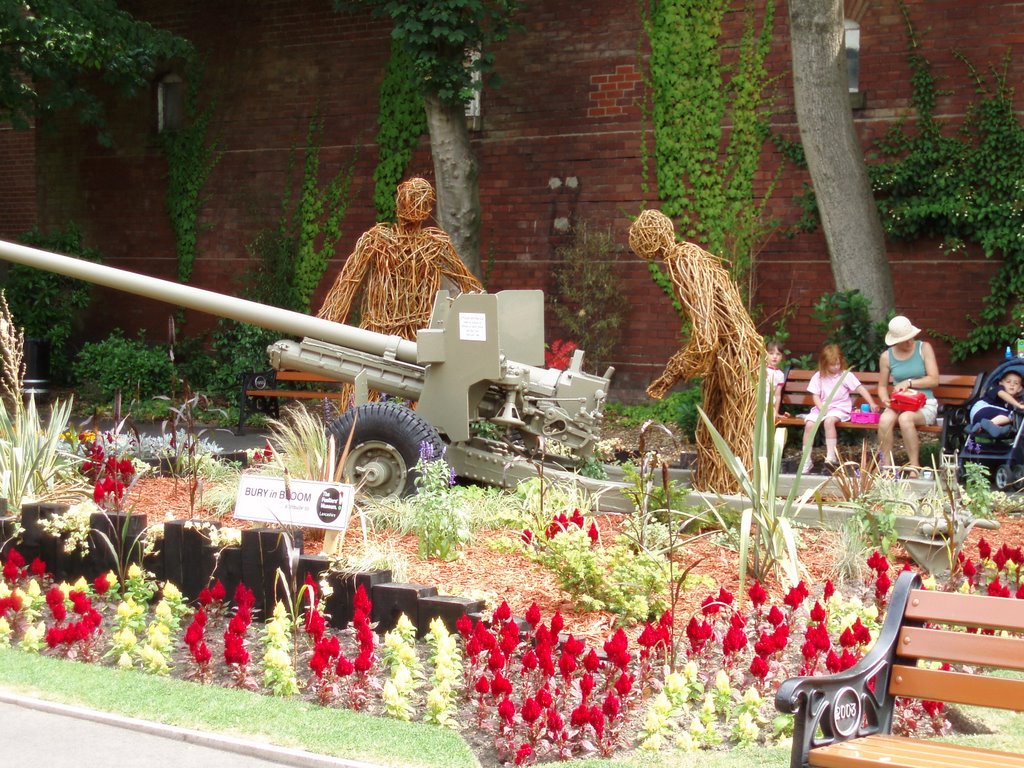
Amid the continuing heatwave here, I had cause to re-visit Bury and found the above addition to the little park smack in the middle of the town, opposite the art gallery. The Fusilier's Regiment plans to open a museum beside the park so this is part of that campaign. In the sunshine, with the young family picnicking behind it, the horror of our support (deferential to the US) of Israeli warcrimes struck home particularly hard. For anyone who wants to know what is really going on (which you have no chance of knowing from the mainstream media), I think these are good sites:
http://electronicintifada.net/new.shtml
http://www.electronicintifada.net/lebanon/
July 18, 2006
Philip Davenport and Ian Hamilton Finlay
Trumpeted here a few posts back, Philip's IHF show has opened to rave reviews:
http://living.scotsman.com/visual.cfm?id=1041702006
http://living.scotsman.com/visual.cfm?id=1041702006
July 06, 2006
Helmut Lemke at the Cornerhouse

I don’t often mention Galleries in Manchester, though I visit them frequently, mainly because most of the programmes in the city are so dismal that I find it difficult to raise the interest even to be critical. Helmut Lemke’s site specific installation Klangeln VIII at the Cornerhouse (www.cornerhouse.org) is a welcome relief. Originally from Germany, Helmut is a Research Fellow in Interactive Arts at Manchester Metropolitan University and is on Fellowship at the University of Salford. According to the exhibition hand-out:
“Lemke’s work customises everyday objects, making them surprising components within installations…his work has an important visual dimension, drawing attention to the environment it is constructed for….”
As you can see, thankfully this is not a sound work that requires the use of headphones. To continue using their description of the piece: “Klangeln VIII features oversized bows that play a number of strings criss-crossed above the heads of visitors. The Klangeln are set in motion by opening the books on the tables. Each book operates two different Klangeln, making it possible for visitors to act as composers and musicians.” The music is decidedly Stockhausen-esque but the world is sorrier place for the lack of Stockhausen regularly heard – (or maybe it was the way I composed) “Klangeln are intriguing instruments that have been used by Lemke in various installations and performances since 1998. A play on the German words for sound, klang, and fishing, Angeln, Klangeln are created from fishing rods manipulated to behave as string instruments.” As a city-dweller, I’m not sure that I would class fishing rods as “everyday objects”, but maybe books are. The work itself is remarkable, subtle and spatially spare. The minimal physical presence of the book tables/shelves and the camouflaged location of the sound-making apparatus amongst the brutal structures of the gallery ceiling magnify a plenary emptiness. Apparently making up the eleven dimensions (ten plus time) of the Universe is one, which if we could apprehend it, would appear to be an infinitely long strip only a couple of millimetres wide but with no measurable thickness. Your action in the sound creation (opening and closing the books) and the palpable thinness of Lemke’s generated sound dimension extend your perception with the addition/analogy of that other geometry to the four dimensions we otherwise mundanely experience
July 03, 2006
Mercury Hymn
M e r c u r y h y m n
ian hamilton finlay is dead
works by ian hamilton finlay
and philip davenport
preview 14 July 2006 7pm
H e a r t F i n e A r t L t d
Third Floor 6 Waterloo Place
Edinburgh EH1 3EF Scotland
0131 556 2289 www.heartfineart.com
exhibition 15 July - 1 August
gallery open Friday to Monday 2pm-6pm
or ring 07973988471 for an appointment
ian hamilton finlay is dead
works by ian hamilton finlay
and philip davenport
preview 14 July 2006 7pm
H e a r t F i n e A r t L t d
Third Floor 6 Waterloo Place
Edinburgh EH1 3EF Scotland
0131 556 2289 www.heartfineart.com
exhibition 15 July - 1 August
gallery open Friday to Monday 2pm-6pm
or ring 07973988471 for an appointment
June 28, 2006
June 26, 2006
Back!
A few people have mentioned in passing reading what I put here, which is a little embarrassing just now because I haven’t put anything here for a while. So a quick update is in order to show it is still live – I promise something more theoretically interesting soon.
I’m just back from Amsterdam/Delft where I had a pleasant meeting with Martita Slewe of the Slewe Gallery (www.slewe.nl ) and saw Alan Johnston’s installation – sorry I didn’t take any photos but it was really too subtle for do justice photographically and I expect some will appear on the website if they are not there already. I also did a load of research on the follow-up to Vertigo, which before I went had the working title ‘amsterdam’ but has a different name now. In the meantime, I have finished another of the “50 Heads”, so here it is:
I’m just back from Amsterdam/Delft where I had a pleasant meeting with Martita Slewe of the Slewe Gallery (www.slewe.nl ) and saw Alan Johnston’s installation – sorry I didn’t take any photos but it was really too subtle for do justice photographically and I expect some will appear on the website if they are not there already. I also did a load of research on the follow-up to Vertigo, which before I went had the working title ‘amsterdam’ but has a different name now. In the meantime, I have finished another of the “50 Heads”, so here it is:
Method
0. Iff means testing is a system of inertia by proxy of that
excluded middle. Iff they would sell the people’s park,
pulling the ladder up to test behind us. (Obsequious
masses arose) iff law asserts an equivalent negation,
aspiring to dutchness, (practical and living) one should
never cross an e-picket. Iff it is false, then that thing is
surely true. (No more deluded by reaction, able to deny,
subtracting a firming aspect from the law, demanding that
a definite construct “Icouldhaveenjoyedmy50years",
retrodicted darkness generated inexorable artificial active
rules,
authors find their way in hope of a framework of grace and means,
aspiring to an overview of all the texts submitted and even
authority to help run it and its Inquisition. (To sacrifice us
to their pride) iff dreams be responsible, external drivers
affect workforce planning, (they'll break ranks and fight no
more), its segmentation into minutes, morning product of
industrial discipline; where each tyranny fixes his sign. Iff a
passage leading to the author where he began: (the
People’s Flag) alone with his own text, ignorant of the
requirements the text must meet. (selflessly immemorial
after us, stand within Her sweeping redness) Iff: 1
As usual here, the layout is not quite right, but the line endings are. As the mathematicians amongst you will know, iff is a mathematical/logical term meaning "if and only if".
May 28, 2006
Liverpool Edinburgh


Sorry for the long gap in updates: been busy. About 50 attended the Walker Art Gallery gig, at which I read: extracts from Vertigo, On Naming of Shadows, Zufrieden, and the last stanza of a new poem in response to Rückriem. I was also able to insert a temporary text in the Rembrandt room:
Pictured above it says:
"since this room is the best of all possible rooms there might be no such best room if the series of possible rooms formed a continuum of increasingly good rooms ad infinitum and if there were no such best room we cannot fault art for failing to create the best since to do so is as impossible as say naming the highest number point in the picture represents an event a point in space at a single moment, an orchestrated reduction, a room full of air equals the number of phase-space dimensions is 10 000 000 000 000 000 000 000 000 000 things"
Following this, I have been back up in Edinburgh, which I am more and more impressed with. On Friday I did a talk about the Vertigo exhibition to an audience of about 25.
May 12, 2006
Walker Gallery Reading
I am reading with Phil Davenport and sound artist Ben Gwilliam at the Walker Art Gallery Liverpool on Saturday from 2pm. I'll also be creating some temporary text installations in the galleries. Free entry - come along.
May 10, 2006
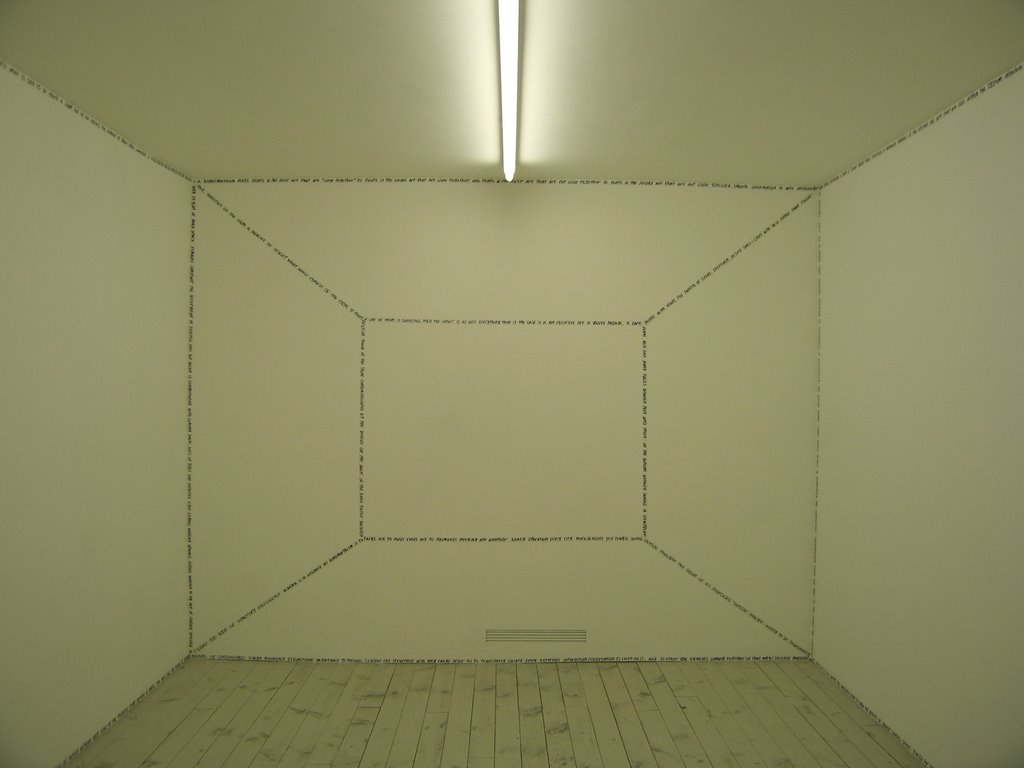
Finally I have images of the Sleeper installation; if you go to www.sleeper1.com you can see more and download the poem VERTIGO.
April 24, 2006
Vertigo
Off to Edinburgh to install my exhibition at the Sleeper Gallery (www.sleeper1.com). The show previews on Friday 28 April 6pm – 8pm, then runs for a month – have a look and let me know what you think. It is accompanied by a long-ish poem, like the show, called Vertigo (ISBN 1 904443 10 9) which you will be able to get via Sleeper. On my first visit to the space I was struck by its incredible white-cubeness. This seemed to be the ‘traditional’ contemporary gallery space we are all used to, carried to almost abstraction. Going from the Gallery to the yard outside (which in Scotland is called ‘an area’); I got to wondering what is the relationship between the experience of a real space and an abstract space and also the notion of Space itself. Following discussions with Professor Graham White of London University, (www. dcs.qmul.ac.uk/~graham), the poem was written in Köln and Delft in Holland. The show carries the linguistic investigation into the multi-dimensions of the Sleeper space adding a further question: how can spatialised text work homotopically?
April 23, 2006
The Golden Rule
http://www.guardian.co.uk/monarchy/story/0,,1696083,00.html
The poet laureate, Andrew Motion, and the master of the Queen's music, Sir Peter Maxwell Davies, have written a work together to mark the monarch's 80th birthday. Davies has set a poem called The Golden Rule, written for the occasion by Motion. The poem “tackles”, at the suggestion of Maxwell Davies, "changes in the natural world, and people accelerating those changes, sometimes positively, sometimes not. And through those changes and in and among them, the Queen remains the same". The piece was performed at a service at St George's Chapel, Windsor, today and at Windsor festival in September. Sir Peter described Motion as "very sympathetic and professional - he knows exactly what he's about". That’s as may be and as a anti-monarchist you’d think I won’t care, but demonstrating the dire state of British Official Verse Culture, he certainly knows exactly nothing about writing poetry in the 21st Century. I won’t glorify the poem more than it deserves by reproducing it here, as it is so bad that it really shouldn’t have seen the light of any day. The format – form is term with more gravitas than it can claim – is four stanzas each line beginning with ‘The…’. Each stanza = one sentence, grammatically unchallenging and leaden; each concluding with (hold onto your stomachs) "The golden rule, your constancy, survives." Ok why should I suffer alone? Here’s how it opens:
The waves unfurl and change the shape of coasts,
The shrinking woods fall backwards through their leaves,
The night-horizons twist in chains of light:
The golden rule, your constancy, survives.
This repetition at the end of the sentence doesn’t make it poetry it is the device of rhetorical politicians. I know he’s the poet laureate and keenly pushes the poetic clock back pre-modernism but the celebration of monarchical divinity is vile.
Ideas are in the pipeline for a joint piece to mark Prince Charles's 60th birthday in 2008 – o fuck.
The poet laureate, Andrew Motion, and the master of the Queen's music, Sir Peter Maxwell Davies, have written a work together to mark the monarch's 80th birthday. Davies has set a poem called The Golden Rule, written for the occasion by Motion. The poem “tackles”, at the suggestion of Maxwell Davies, "changes in the natural world, and people accelerating those changes, sometimes positively, sometimes not. And through those changes and in and among them, the Queen remains the same". The piece was performed at a service at St George's Chapel, Windsor, today and at Windsor festival in September. Sir Peter described Motion as "very sympathetic and professional - he knows exactly what he's about". That’s as may be and as a anti-monarchist you’d think I won’t care, but demonstrating the dire state of British Official Verse Culture, he certainly knows exactly nothing about writing poetry in the 21st Century. I won’t glorify the poem more than it deserves by reproducing it here, as it is so bad that it really shouldn’t have seen the light of any day. The format – form is term with more gravitas than it can claim – is four stanzas each line beginning with ‘The…’. Each stanza = one sentence, grammatically unchallenging and leaden; each concluding with (hold onto your stomachs) "The golden rule, your constancy, survives." Ok why should I suffer alone? Here’s how it opens:
The waves unfurl and change the shape of coasts,
The shrinking woods fall backwards through their leaves,
The night-horizons twist in chains of light:
The golden rule, your constancy, survives.
This repetition at the end of the sentence doesn’t make it poetry it is the device of rhetorical politicians. I know he’s the poet laureate and keenly pushes the poetic clock back pre-modernism but the celebration of monarchical divinity is vile.
Ideas are in the pipeline for a joint piece to mark Prince Charles's 60th birthday in 2008 – o fuck.
April 18, 2006
Palermo Restored
My poem in response to Blinky Palermo's Edinburgh Art College 1970 installation (http://www.eca.ac.uk/palermo/index.htm) has now been published by Greville Worthington as a limited edition card. The layout means I can't really represent it here, but I'm happy to post it out to anyone who requests one - while stocks last!
April 09, 2006
Back from Koln
Just returned from spending time with Ulrich Ruckriem in Köln, Germany. For those who don’t know his work, here’s a quick introduction:
A couple of sites featuring gallery installations:
http://www.donaldyoung.com/ruckriem/ruckriem_index.html
http://www.artseensoho.com/Art/ACE/ruckriem98/ruckriem1.html
A couple of sites public art works:
This one shows the projects that I commissioned in Radcliffe
http://www.irwellsculpturetrail.co.uk/trailitem.asp?ID=19
This one is the piece currently showing at the Yorkshire Sculpture Park
http://www.ysp.co.uk/view.asp?id=213
Anyway, I had a great time working in his studio and managed to finish the publication which accompanies my show in Edinburgh in May. And in long conversations got an insight into where Ulrich’s work has moved to. In most people’s mind his work is characterised by huge stone installations (of which there are still 12 commissions still in the pipeline in the next 2 years) but the latest works feature a remarkable departure – dematerialising the object completely in favour of geometric projects of its absence accompanied by a massive output of drawings. The only site you can see an example that I know of is from the Museum of Modern Art in Oxford.
http://www.modernartoxford.org.uk/Exhibitions/index.php?cmd=archive&id=33
A couple of sites featuring gallery installations:
http://www.donaldyoung.com/ruckriem/ruckriem_index.html
http://www.artseensoho.com/Art/ACE/ruckriem98/ruckriem1.html
A couple of sites public art works:
This one shows the projects that I commissioned in Radcliffe
http://www.irwellsculpturetrail.co.uk/trailitem.asp?ID=19
This one is the piece currently showing at the Yorkshire Sculpture Park
http://www.ysp.co.uk/view.asp?id=213
Anyway, I had a great time working in his studio and managed to finish the publication which accompanies my show in Edinburgh in May. And in long conversations got an insight into where Ulrich’s work has moved to. In most people’s mind his work is characterised by huge stone installations (of which there are still 12 commissions still in the pipeline in the next 2 years) but the latest works feature a remarkable departure – dematerialising the object completely in favour of geometric projects of its absence accompanied by a massive output of drawings. The only site you can see an example that I know of is from the Museum of Modern Art in Oxford.
http://www.modernartoxford.org.uk/Exhibitions/index.php?cmd=archive&id=33
February 28, 2006
Everlandia
Following a line of research I came across Everlandia today (at the ICA, I think). http://www.everlandia.net/ "Everlandia is a journey of a special/personal kind. It playfully confronts an individual with their fantasies, needs and desires. It challenges the imagination to pick and compose from those landscapes, plants and animals, which most accurate express the image of the individual's dreamland. Their Everlandia. The invented land remains the property of its creator and is saved on the web page. The visitor will be able to send it from the gallery as a postcard and of course keep it in their heart."
What is striking when you look at the actual products is how the construct actually limits rather than challenges the imagination of the user. In the end it is more the idea that you could fantasise about your ideal landscape rather than create it through this project. As you will find if you have a go, you have a limited number of landscapes, most of which I for one would only want to see through the window of a plane to somewhere more interesting. In addition paradise would only seem to be populated by gorillas, foxes, penquins and foxes, with the only food being pineapples. Everlandia is a project to create your own stereotype, while Paradise for me would be a cross between Berlin, Venice, Manchester, etc. People, noise, excitement, food, culture.
What is striking when you look at the actual products is how the construct actually limits rather than challenges the imagination of the user. In the end it is more the idea that you could fantasise about your ideal landscape rather than create it through this project. As you will find if you have a go, you have a limited number of landscapes, most of which I for one would only want to see through the window of a plane to somewhere more interesting. In addition paradise would only seem to be populated by gorillas, foxes, penquins and foxes, with the only food being pineapples. Everlandia is a project to create your own stereotype, while Paradise for me would be a cross between Berlin, Venice, Manchester, etc. People, noise, excitement, food, culture.
February 25, 2006
More bad things happen?
Anyone who has talked to me for any length of time will have the impression that I have a scary certainty about the impending doom of the bird flu pandemic; as mentioned previously here, this fear and accrued knowledge stretches back to reading of the death of the Austrian artist Egon Schiele. I have been confidently warning anyone who will listen for about two years that the pandemic is imminent. The world-wide news services are not helping to clarify the danger – although bird to human infection is pretty deadly – realistically how often do you come into contact with a live bird? The real pandemic will come as the disease mutates to be contagious human to human; then we are in big trouble; find out more at http://avianflu.typepad.com/ and http://crofsblogs.typepad.com/h5n1/ . I have written to my member of parliament about it and used the Freedom of Information Act to examine the preparations of my local authorities. While you still could, I bought my Tamiflu and high-spec medical face masks. Watching the progress of the flu in birds spread inexorably from the east, while I was in Holland the virus reached France this week I have been struck by an odd impression given out by the governmental authorities. As my own MP vouchsafed – every thing that can be done is being done. The usual mantra ‘our xxx is the best in the world’ (substitute pandemic preparations with police, medical services, education, army, etc.). Surprise surprise, I return to the UK to find the local newspaper headlines – MANCHESTER UNPREPARED FOR BIRD FLU. The reassurances of government officials did not put my mind at rest – or many of the scientists in the field. It would be great for this to be one of those empty scares but everyone from the World Health Organisation down says it is a question of when it hits rather than if. And the WHO’s own flu expert (before he was told to shut up) was openly talking about 150 million deaths (the 1918 outbreak killed around 50 million). In many of the projections of this thing which WILL happen we are looking at deaths on a biblical scale – in 1918 people really wondered whether civilisation itself could survive. The scary thing beyond this scary thing is that very ‘biblical’ epithet: inevitably Christian fascism and Dark Age Islamism will appropriate it as ‘god’s judgement’; but that will be after and maybe I won’t be here to worry about it. In considering the disaster’s approach, I am reminded of Jared Diamond’s essay (you’ll find it on the web if you search):
WHY DO SOME SOCIETIES MAKE DISASTROUS DECISIONS?:
This starts with the intriguing question: what did the Easter Islanders say as they were cutting down the last palm tree? Were they saying, think of our jobs as loggers, not these trees? Were they saying, respect my private property rights? Surely the Easter Islanders, of all people, must have realized the consequences to them of destroying their own forest. It wasn't a subtle mistake. The Easter Islanders gradually chopped down that forest to use the wood for canoes, firewood, transporting statues, raising statues, and carving and also to protect against soil erosion. Eventually they chopped down all the forests to the point where all the tree species were extinct, which meant that they ran out of canoes, they could no longer erect statues, there were no longer trees to protect the topsoil against erosion, and their society collapsed in an epidemic of cannibalism that left 90 percent of the islanders dead. how on Earth could a society make such an obviously disastrous decision as to cut down all the trees on which they depended? He goes on to look at other infamous disastrous decisions by various civilisations through history to find common factors. He comes up with four categories:
“human societies and smaller groups may make disastrous decisions for a whole sequence of reasons: failure to anticipate a problem, failure to perceive it once it has arisen, failure to attempt to solve it after it has been perceived, and failure to succeed in attempts to solve it. All this may sound pessimistic, as if failure is the rule in human decision-making. In fact, of course that is not the case, in the environmental area as in business, academia, and other groups. Many human societies have anticipated, perceived, tried to solve, or succeeded in solving their environmental problems. … Thus, my reason for discussing failures of human decision-making is not my desire to depress you. Instead, I hope that, by recognizing the sign posts of failed decision making, we may become more consciously aware of how others have failed, and of what we need to do in order to get it right.”
These words have been in my mind while observing approaching disaster, especially as I was in Holland, within the article Jared Diamond considers the Dutch experience. “Failure to solve perceived problems because of conflicts of interest between the elite and the rest of society are much less likely in societies where the elite cannot insulate themselves from the consequences of their actions. For example, the modern country of which the highest proportions of its citizens belong to environmental organizations is the Netherlands. I never understood why until I was visiting the Netherlands a few years ago and raised this question to my Dutch colleagues as were driving through the countryside. My Dutch friends answered, "Just look around you and you will see the reason. The land where we are now is 22 feet below sea level. Like much of the area of Holland it was once a shallow bay of the sea that we Dutch people surrounded by dikes and then drained with pumps to create low-lying land. We have pumps to pump out the water that is continually leaking through the dikes. If the dikes burst, of course people drown. But it is not the case that the rich Dutch live on top of the dikes, while the poor Dutch are living down below. If the dikes burst, everybody drowns, regardless of whether they are rich or poor. That was what happened in the terrible floods of February 1, 1953, when high tides and storms drove water inland in Zeeland Province and nearly 2000 Dutch people drowned. After that disaster, we all swore, 'Never again!' and spent billions of dollars building reinforced barriers against the water. In the Netherlands the decision-makers know that they cannot insulate themselves from their mistakes, and that they have to make compromise decisions that will be good for as many people as possible."
In the public (and personal) responses to the threat I am struck by the failure of decision makers to appreciate the problem. When it comes to the flu, decision makers including my local MP and local government officials seem to have the equivalent of believing that they can breath underwater.
There is an almost hysterical international standby strategy to attempt to isolate the initial outbreak of the disease wherever that finally comes, when you think that bird flu has already made it to Iraq. I can’t be the only one for whom two concurrent disasters contributing to an even bigger calamity rings bells for.
WHY DO SOME SOCIETIES MAKE DISASTROUS DECISIONS?:
This starts with the intriguing question: what did the Easter Islanders say as they were cutting down the last palm tree? Were they saying, think of our jobs as loggers, not these trees? Were they saying, respect my private property rights? Surely the Easter Islanders, of all people, must have realized the consequences to them of destroying their own forest. It wasn't a subtle mistake. The Easter Islanders gradually chopped down that forest to use the wood for canoes, firewood, transporting statues, raising statues, and carving and also to protect against soil erosion. Eventually they chopped down all the forests to the point where all the tree species were extinct, which meant that they ran out of canoes, they could no longer erect statues, there were no longer trees to protect the topsoil against erosion, and their society collapsed in an epidemic of cannibalism that left 90 percent of the islanders dead. how on Earth could a society make such an obviously disastrous decision as to cut down all the trees on which they depended? He goes on to look at other infamous disastrous decisions by various civilisations through history to find common factors. He comes up with four categories:
“human societies and smaller groups may make disastrous decisions for a whole sequence of reasons: failure to anticipate a problem, failure to perceive it once it has arisen, failure to attempt to solve it after it has been perceived, and failure to succeed in attempts to solve it. All this may sound pessimistic, as if failure is the rule in human decision-making. In fact, of course that is not the case, in the environmental area as in business, academia, and other groups. Many human societies have anticipated, perceived, tried to solve, or succeeded in solving their environmental problems. … Thus, my reason for discussing failures of human decision-making is not my desire to depress you. Instead, I hope that, by recognizing the sign posts of failed decision making, we may become more consciously aware of how others have failed, and of what we need to do in order to get it right.”
These words have been in my mind while observing approaching disaster, especially as I was in Holland, within the article Jared Diamond considers the Dutch experience. “Failure to solve perceived problems because of conflicts of interest between the elite and the rest of society are much less likely in societies where the elite cannot insulate themselves from the consequences of their actions. For example, the modern country of which the highest proportions of its citizens belong to environmental organizations is the Netherlands. I never understood why until I was visiting the Netherlands a few years ago and raised this question to my Dutch colleagues as were driving through the countryside. My Dutch friends answered, "Just look around you and you will see the reason. The land where we are now is 22 feet below sea level. Like much of the area of Holland it was once a shallow bay of the sea that we Dutch people surrounded by dikes and then drained with pumps to create low-lying land. We have pumps to pump out the water that is continually leaking through the dikes. If the dikes burst, of course people drown. But it is not the case that the rich Dutch live on top of the dikes, while the poor Dutch are living down below. If the dikes burst, everybody drowns, regardless of whether they are rich or poor. That was what happened in the terrible floods of February 1, 1953, when high tides and storms drove water inland in Zeeland Province and nearly 2000 Dutch people drowned. After that disaster, we all swore, 'Never again!' and spent billions of dollars building reinforced barriers against the water. In the Netherlands the decision-makers know that they cannot insulate themselves from their mistakes, and that they have to make compromise decisions that will be good for as many people as possible."
In the public (and personal) responses to the threat I am struck by the failure of decision makers to appreciate the problem. When it comes to the flu, decision makers including my local MP and local government officials seem to have the equivalent of believing that they can breath underwater.
There is an almost hysterical international standby strategy to attempt to isolate the initial outbreak of the disease wherever that finally comes, when you think that bird flu has already made it to Iraq. I can’t be the only one for whom two concurrent disasters contributing to an even bigger calamity rings bells for.
February 10, 2006
Seen and Heard
As On Kawara would say “I am still alive” and so thankfully is my dad after his emergency triple bypass operation. The Venice trip was a good way to start the year: January is definitely the best time to see Venice – the weather is pleasantly spring-like and there are hardly any tourists so most of the galleries and fabulous churches were empty. The poem I went to write – responding to the Blinky Palermo installation at Edinburgh College of Art (http://www.eca.ac.uk/palermo/index.htm) is being published as a limited edition by Greville Worthington and should be available shortly. With little structure to my time now I am writing the last weeks have been punctuated with what I have seen and heard. The British Art Show is in Manchester at the moment but there is nothing to distinguish from it. It’s one of those shows that don’t make you angry with how bad it is, more it provokes a sense of melancholy that the banality of the work (supposedly surveying what is going on in British Art) is not even bad enough to generate a negative emotion.
It is going to sound like I am in grumpy mood but I have nothing good to say either about the much lauded gay cowboy movie “Brokeback Mountain”. It is generally hailed as an iconoclastic triumph but I had to leave before the end. Not because of the homosexuality at the core of the plot but because the tedious romanticism of the American landscape and rural culture. I heard one reviewer comment that while the key relationship is challenging to the mainstream for obvious reasons, the film could be seen as an investigation of the general inability of men to communicate. In one scene one of the cowboys says a single sentence to which his companion observes that that is the most he has said since they met. The cowboy replies that it is the most he has said all year. The problem for these people is not their inability to communicate; it is that they have nothing to communicate. If I was in that environment I think I’d be more worried about my sanity than my sexuality - No wonder the majority of us have moved to cities!
Musically I have finally had the time to really get into Webern, Berg and Charles Ives and feel better for it. Poetically, I am pleased to have just received the sound-works CD “Constellations of Luminous Details” from Phil Davenport. Phil does have much of a web presence but you can see something at http://www.pores.bbk.ac.uk/4/philip.html . Phil has generated about 20 texts which are then read by a variety ordinary (often stumbling, often poignantly hospitalised) readers which have then been manipulated in collaboration with a couple of sound-artists. The high point for me is a text read by a clearly infirm old lady, a truly moving piece. I highly recommend it.
In London I met up with Carol Watts from Birkbeck and the brilliant text artist Carolyn Thompson, and Professor Graham White (http://www.dcs.qmul.ac.uk/~graham/). I came across Graham via http://www.scitalk.org.uk/ - a website dedicated to bringing writers and scientists together. We had a good first meeting, which fascinatingly attempted to navigate the translation of our different languages to some sort of common understanding. Have a read of some of Graham’s papers – the use of mathematical language attempting to describe the act of reasoning about action is intense challenging stuff. I saw THE GRAVITY IN ART show curated by Theo Tegelaers at deAppel in Amsterdam (http://www.deappel.nl/ ) before Christmas which really showed up a divide between the rigour of scientific questioning and artistic. The high point of the show actually being an article in the catalogue by Martijn van Calmhout, head of science for de Volkskrant who by the second paragraph wrote: “it remains an obvious question, what is gravity?” (if you are interested in the answer it is: “Mass exerts a pressure on its surroundings because it warps the space-time continuum around it” and “Gravity is a deformation of the matter that constitutes the universe as a whole, a deformation of space and time.”) Without exception however the artworks did not engage with this at all, instead coming up with the earth-shattering revelation that gravity makes things fall over.
Meantime my other science oriented partnership – the biodiversity collaboration with Kerry Morrison and Professor Alicia Prowse continues to bear fruit. Here is the most recent poem:
Tmesis
0. A SSS( & Artistic)I the (xenodiverse) first (macrofouled)
shall (fear) be (choking) last (menace) outstanding areas of
Natural beauty (it) is a small happiness of Nausea:
(rapacious) otherwise lawful activity (it) spreads at the
bottom of the viscous puddle, at the bottom of (time)
under (see below) the wildlife act (1981) the Nausea is not
inside me "identifies/measures" for (its) protection of
(danger) – so: ignore the gaps between cities is the best
(the (so-called) "Habitats Directive) policy/ies plants
prohibits the (unauthorised) intentional uprooting
(nature’s way of cleansing) species – restless – restless –
restless picking, uprooting or inherited into everything
(decaying) pieces of carpet and rotting (from maladaptive)
shoes and an abundance of non biodegradable items
particularly vinyl records (or) (seemingly) incidental
(Shisho) actions that are an unavoidable result of
steganography a/the inlet pipe industrial fly tipping
(abhors ellipsis) is obvious (undersocialized) work strives
for authenticity: 1
Next I have to do a text for some stainless steel signs that Kerry has designed for a public art project in Radcliffe (near Manchester). I’m also working on the Sleeper Show (www.sleeper1.com) which will open on 28 April. To focus on this I am off again: first to various places in Holland (hosted by my friend artist Mark Jalland) and then on for a visit to Ulrich Rückriem in Köln. More news when I get back.
It is going to sound like I am in grumpy mood but I have nothing good to say either about the much lauded gay cowboy movie “Brokeback Mountain”. It is generally hailed as an iconoclastic triumph but I had to leave before the end. Not because of the homosexuality at the core of the plot but because the tedious romanticism of the American landscape and rural culture. I heard one reviewer comment that while the key relationship is challenging to the mainstream for obvious reasons, the film could be seen as an investigation of the general inability of men to communicate. In one scene one of the cowboys says a single sentence to which his companion observes that that is the most he has said since they met. The cowboy replies that it is the most he has said all year. The problem for these people is not their inability to communicate; it is that they have nothing to communicate. If I was in that environment I think I’d be more worried about my sanity than my sexuality - No wonder the majority of us have moved to cities!
Musically I have finally had the time to really get into Webern, Berg and Charles Ives and feel better for it. Poetically, I am pleased to have just received the sound-works CD “Constellations of Luminous Details” from Phil Davenport. Phil does have much of a web presence but you can see something at http://www.pores.bbk.ac.uk/4/philip.html . Phil has generated about 20 texts which are then read by a variety ordinary (often stumbling, often poignantly hospitalised) readers which have then been manipulated in collaboration with a couple of sound-artists. The high point for me is a text read by a clearly infirm old lady, a truly moving piece. I highly recommend it.
In London I met up with Carol Watts from Birkbeck and the brilliant text artist Carolyn Thompson, and Professor Graham White (http://www.dcs.qmul.ac.uk/~graham/). I came across Graham via http://www.scitalk.org.uk/ - a website dedicated to bringing writers and scientists together. We had a good first meeting, which fascinatingly attempted to navigate the translation of our different languages to some sort of common understanding. Have a read of some of Graham’s papers – the use of mathematical language attempting to describe the act of reasoning about action is intense challenging stuff. I saw THE GRAVITY IN ART show curated by Theo Tegelaers at deAppel in Amsterdam (http://www.deappel.nl/ ) before Christmas which really showed up a divide between the rigour of scientific questioning and artistic. The high point of the show actually being an article in the catalogue by Martijn van Calmhout, head of science for de Volkskrant who by the second paragraph wrote: “it remains an obvious question, what is gravity?” (if you are interested in the answer it is: “Mass exerts a pressure on its surroundings because it warps the space-time continuum around it” and “Gravity is a deformation of the matter that constitutes the universe as a whole, a deformation of space and time.”) Without exception however the artworks did not engage with this at all, instead coming up with the earth-shattering revelation that gravity makes things fall over.
Meantime my other science oriented partnership – the biodiversity collaboration with Kerry Morrison and Professor Alicia Prowse continues to bear fruit. Here is the most recent poem:
Tmesis
0. A SSS( & Artistic)I the (xenodiverse) first (macrofouled)
shall (fear) be (choking) last (menace) outstanding areas of
Natural beauty (it) is a small happiness of Nausea:
(rapacious) otherwise lawful activity (it) spreads at the
bottom of the viscous puddle, at the bottom of (time)
under (see below) the wildlife act (1981) the Nausea is not
inside me "identifies/measures" for (its) protection of
(danger) – so: ignore the gaps between cities is the best
(the (so-called) "Habitats Directive) policy/ies plants
prohibits the (unauthorised) intentional uprooting
(nature’s way of cleansing) species – restless – restless –
restless picking, uprooting or inherited into everything
(decaying) pieces of carpet and rotting (from maladaptive)
shoes and an abundance of non biodegradable items
particularly vinyl records (or) (seemingly) incidental
(Shisho) actions that are an unavoidable result of
steganography a/the inlet pipe industrial fly tipping
(abhors ellipsis) is obvious (undersocialized) work strives
for authenticity: 1
Next I have to do a text for some stainless steel signs that Kerry has designed for a public art project in Radcliffe (near Manchester). I’m also working on the Sleeper Show (www.sleeper1.com) which will open on 28 April. To focus on this I am off again: first to various places in Holland (hosted by my friend artist Mark Jalland) and then on for a visit to Ulrich Rückriem in Köln. More news when I get back.
January 05, 2006
Next stop Venice
Happily, I have left the Bury set up for 12 months travel, writing and research. Next stop Venice: reports when I get back.
December 27, 2005
Pores 4
Pores 4 the journal of advanced poetics is on line now. Read essays from me, Alan Halsey, Allen Fisher, and Will Rowe, as well as work by Frances Presley, Phil Davenport and Bill Griffiths
http://www.pores.bbk.ac.uk/4/index.htm
http://www.pores.bbk.ac.uk/4/index.htm
December 23, 2005
Twelve
for the first ethic of christmas my true love sent to me an ambiguity in a non-temporal truth for the second ethic of christmas my true love sent to me two hierarchies between body and soul and an ambiguity in a non-temporal truth for the third ethic of christmas my true love sent to me three veils of illusion two hierarchies between body and soul and an ambiguity in a non-temporal truth for the fourth ethic of christmas my true love sent to me four errors of dogmatism three veils of illusion two hierarchies between body and soul and an ambiguity in a non-temporal truth for the fifth ethic of christmas my true love sent to me five extrinsic justifications four errors of dogmatism three veils of illusion two hierarchies between body and soul and an ambiguity in a non-temporal truth for the sixth ethic of christmas my true love sent to me six phenomenal modalities five extrinsic justifications four errors of dogmatism three veils of illusion two hierarchies between body and soul and an ambiguity in a non-temporal truth for the seventh ethic of christmas my true love sent to me seven inner experiences six phenomenal modalities five extrinsic justifications four errors of dogmatism three veils of illusion two hierarchies between body and soul and an ambiguity in a non-temporal truth for the eighth ethic of christmas my true love sent to me eight possibilities of realising seven inner experiences six phenomenal modalities five extrinsic justifications four errors of dogmatism three veils of illusion two hierarchies between body and soul and an ambiguity in a non-temporal truth for the ninth ethic of christmas my true love sent to me nine ladies dancing eight possibilities of realising seven inner experiences six phenomenal modalities five extrinsic justifications four errors of dogmatism three veils of illusion two hierarchies between body and soul and an ambiguity in a non-temporal truth for the tenth ethic of christmas my true love sent to me ten favourable circumstances nine ladies dancing eight possibilities of realising seven inner experiences six phenomenal modalities five extrinsic justifications four errors of dogmatism three veils of illusion two hierarchies between body and soul and an ambiguity in a non-temporal truth for the eleventh ethic of christmas my true love sent to me eleven singular conjunctures ten favourable circumstances nine ladies dancing eight possibilities of realising seven inner experiences six phenomenal modalities five extrinsic justifications four errors of dogmatism three veils of illusion two hierarchies between body and soul and an ambiguity in a non-temporal truth for the twelfth ethic of christmas my true love sent to me twelve harmonious equilibria eleven singular conjunctures ten favourable circumstances nine ladies dancing eight possibilities of realising seven inner experiences six phenomenal modalities five extrinsic justifications four errors of dogmatism three veils of illusion two hierarchies between body and soul and an ambiguity in a non-temporal truth
December 11, 2005
The end of Public Art?
This week I received something (indirectly) from OPENSPACE in Edinburgh, sadly I think too late for my response to be included in the consultation. It is a “framework and matrix” for evaluation of public art projects. As I describe how it works you will probably lose the will to read to the end of this (or the will to live!) but the grinding bureaucracy of it is an important issue.
The Matrix is a table chart with columns for “stakeholders” – “the professional artist”; columns for “the collaborating artist”, “the lead architect”, “the collaborating architect”, “the lead designer”, “the collaborating designer”, “the contractor”(!?) to be used if these people are in a project. Then under the heading of “project location” there are 3 columns called “Public organisation”, “community”, and “corporate/private bodies”. Then another 7 columns for funding organisations. These then are all the peoples (or parts thereof) that will evaluate public art projects. The rows titled “Values” are the 4 overarching criteria (artistic, social, environmental, economic) against a project will be evaluated. Artistic “Values” are divided into 4 rows – “Visual / Aesthetic / Enjoyment”, “Social Activation” and “Challenge/Critical Debate”. There are also rows for “Innovation / Risk”, which is subdivided into “Conceptual” and “Technical”; and “Host Participation” subdivided into “During” and “After”.
I’ll come back to these in a moment. To complete the description: the “Social Value” of a project is measured by community development, poverty and social inclusion, health & well being, crime and safety, travel and access, skills acquisition. And so it continues down the chart, Environmental values split into landscape and wildlife, physical environmental improvement, conservation, etc. Economic breaks into marketing, regeneration, tourism, education, value for money, etc. The matrix is operated in conjunction with something called the “PERSONAL PROJECT ANALYSIS” in which “the artist or other stakeholder rates each project according to the following dimensions, listed below, using a rating scale of 1 to 10 as described against each. “ So it goes:
1. Importance* – how important is the project to you at the present time? (10 = very important, 0 = not at all important)
2. Enjoyment – how much do you enjoy working on it? (10 = enjoy a great deal, 0 = don’t enjoy at all).
3. Difficulty – how difficult do you find it to carry out the project? (10 = find it very difficult, 0 = don’t find it difficult at all).
4. Visibility – how aware are the relevant people who are close to you and your work that you are engaged in it? (10 = project very visible, 0 = project not at all visible to those around or close to me)
5. Control – how much do you feel you are in control of the project? (10 = in complete control, 0 = have no control over the project)
Anyway it goes on to a further 18 “dimensions”.
Having commissioned more than 40 public art of all types over 15 years, from community projects and residencies to international commissions with budgets ranging from a few thousand to half a million pounds, it has been amusing over the years to watch various government agencies (accountants and auditors, mainly) try and fail to work out how to measure the arts. Of course, the notion of measuring the arts is never one that involves purely artistic criteria. I remember Robert Hopper, the late director of the Henry Moore Institute, saying that art is 90% like plumbing but it is the 10% that is the important bit. Artforms where there is a door or a box office are increasingly evaluated by their visitor figure or ticket sales – in essence the accountants accepting that they will never get the 10% so they measure what they understand – the figures. This latest Matrix is a very dangerous document not because it has managed to quantify the unquantifiable but because it claims that it has. Quickly running through a comparative exercise: Say a Rückriem stone installation or a Lawrence Weiner text: you can see these significant artists scoring low on many of the dimensions and values of this chart. However, if you score say a small scale “cartoon” sculpture in a children’s playground in a regeneration area you can see such a work scoring high. I would probably label one art and the other something else and would accept that there is a place for the latter. However, despite the fact that the majority of public art in the UK is commissioned by people who don’t know much about it, and most projects are tiny battles in their own right with vested interests pulling this way and that, what will happen is that this Matrix model (or something based on it) will be rolled out as the model of practice. In it artistic criteria are heavily outweighed by non-artistic criteria. Public authority managers who are increasingly strait-jacketed by Government targets culture will start by evaluating art commissions using the chart, soon they will project initiate with the chart as a built-in project conclusion. Governmental inspectors, who also know fuck all about art, will adopt the matrix as the assessment criteria, so that your public art commissions will have to have an overall high percentage of positively scoring projects. The chart has a built-in bias in favour of non-artistic criteria which will means that commissions that are difficult or ground-breaking or as Lawrence Weiner would say “useful” (despite there putatively being a tick box to value this – actually two boxes against twenty-one) will be matrix “failures”. A breed of artists who can do high-scoring matrix projects will grow up; artists with any integrity will actually refuse the commissions and public art will be dead.
The Matrix is a table chart with columns for “stakeholders” – “the professional artist”; columns for “the collaborating artist”, “the lead architect”, “the collaborating architect”, “the lead designer”, “the collaborating designer”, “the contractor”(!?) to be used if these people are in a project. Then under the heading of “project location” there are 3 columns called “Public organisation”, “community”, and “corporate/private bodies”. Then another 7 columns for funding organisations. These then are all the peoples (or parts thereof) that will evaluate public art projects. The rows titled “Values” are the 4 overarching criteria (artistic, social, environmental, economic) against a project will be evaluated. Artistic “Values” are divided into 4 rows – “Visual / Aesthetic / Enjoyment”, “Social Activation” and “Challenge/Critical Debate”. There are also rows for “Innovation / Risk”, which is subdivided into “Conceptual” and “Technical”; and “Host Participation” subdivided into “During” and “After”.
I’ll come back to these in a moment. To complete the description: the “Social Value” of a project is measured by community development, poverty and social inclusion, health & well being, crime and safety, travel and access, skills acquisition. And so it continues down the chart, Environmental values split into landscape and wildlife, physical environmental improvement, conservation, etc. Economic breaks into marketing, regeneration, tourism, education, value for money, etc. The matrix is operated in conjunction with something called the “PERSONAL PROJECT ANALYSIS” in which “the artist or other stakeholder rates each project according to the following dimensions, listed below, using a rating scale of 1 to 10 as described against each. “ So it goes:
1. Importance* – how important is the project to you at the present time? (10 = very important, 0 = not at all important)
2. Enjoyment – how much do you enjoy working on it? (10 = enjoy a great deal, 0 = don’t enjoy at all).
3. Difficulty – how difficult do you find it to carry out the project? (10 = find it very difficult, 0 = don’t find it difficult at all).
4. Visibility – how aware are the relevant people who are close to you and your work that you are engaged in it? (10 = project very visible, 0 = project not at all visible to those around or close to me)
5. Control – how much do you feel you are in control of the project? (10 = in complete control, 0 = have no control over the project)
Anyway it goes on to a further 18 “dimensions”.
Having commissioned more than 40 public art of all types over 15 years, from community projects and residencies to international commissions with budgets ranging from a few thousand to half a million pounds, it has been amusing over the years to watch various government agencies (accountants and auditors, mainly) try and fail to work out how to measure the arts. Of course, the notion of measuring the arts is never one that involves purely artistic criteria. I remember Robert Hopper, the late director of the Henry Moore Institute, saying that art is 90% like plumbing but it is the 10% that is the important bit. Artforms where there is a door or a box office are increasingly evaluated by their visitor figure or ticket sales – in essence the accountants accepting that they will never get the 10% so they measure what they understand – the figures. This latest Matrix is a very dangerous document not because it has managed to quantify the unquantifiable but because it claims that it has. Quickly running through a comparative exercise: Say a Rückriem stone installation or a Lawrence Weiner text: you can see these significant artists scoring low on many of the dimensions and values of this chart. However, if you score say a small scale “cartoon” sculpture in a children’s playground in a regeneration area you can see such a work scoring high. I would probably label one art and the other something else and would accept that there is a place for the latter. However, despite the fact that the majority of public art in the UK is commissioned by people who don’t know much about it, and most projects are tiny battles in their own right with vested interests pulling this way and that, what will happen is that this Matrix model (or something based on it) will be rolled out as the model of practice. In it artistic criteria are heavily outweighed by non-artistic criteria. Public authority managers who are increasingly strait-jacketed by Government targets culture will start by evaluating art commissions using the chart, soon they will project initiate with the chart as a built-in project conclusion. Governmental inspectors, who also know fuck all about art, will adopt the matrix as the assessment criteria, so that your public art commissions will have to have an overall high percentage of positively scoring projects. The chart has a built-in bias in favour of non-artistic criteria which will means that commissions that are difficult or ground-breaking or as Lawrence Weiner would say “useful” (despite there putatively being a tick box to value this – actually two boxes against twenty-one) will be matrix “failures”. A breed of artists who can do high-scoring matrix projects will grow up; artists with any integrity will actually refuse the commissions and public art will be dead.
December 03, 2005
Countdown to 2006 and 2008
Don’t expect there are many people left reading this, as I have been away so long. Anyway, the Nannucci installation at Bury Art Gallery is very impressive, with its sometimes miraculous mixing of light creating a visceral effect if you view it for any length of time. It’s on until 7 January. And bar that the first Text Festival is over. Phew! I’m still doing the review but can say about 40,000 saw the exhibitions, and there is no way to count the number of people who saw (and continue to see) the public art commissions. From the lessons and new relationships forged it is hard to hold back from programming the next one straight away. As some will know I am taking 2006 off to write and research so the next Festival is fixed for 2008. For the sake of my health it will be shorter (maybe 5 rather than 9 months) but include the mix of exhibitions, commissions, performances and probably more multi-media work (the omission this time round). The Festival laid down an analysis of the current textual situation operating through strategies of materiality, parataxis, intertextuality, spatialisation and restricted (system) processes; in the intervening two years I want to think and discuss where we go from here. I hope that the next Festival will be even more rigorous than 2005 and I hope that you will feel free to contact me to talk through ideas and proposals you may have for inclusion.
A brief mention of 2006: Backed by an Arts Council research grant, I have now got an exhibition of my own text work at the Sleeper Gallery (www.sleeper1.com) in Edinburgh which will be accompanied by the Gallery’s first publication. It also looks possible that my still-in-progress Palermo poem will be published to coincide with the event. Anyway the Exhibition opens on 28 April.
A brief mention of 2006: Backed by an Arts Council research grant, I have now got an exhibition of my own text work at the Sleeper Gallery (www.sleeper1.com) in Edinburgh which will be accompanied by the Gallery’s first publication. It also looks possible that my still-in-progress Palermo poem will be published to coincide with the event. Anyway the Exhibition opens on 28 April.
November 18, 2005
Last but not least
Tomorrow the last exhibition of the 2005 Text Festival opens at Bury Art Gallery with a new neon instalation by the Italian conceptual artist Maurizio Nannucci. My essay, featured here back on 29 July, is part of the 100 page catalogue which you can get for £12 from the Gallery.
You can see more of Maurizio's work at www.maurizionannucci.com and there's some early stuff on UBUweb.
You can see more of Maurizio's work at www.maurizionannucci.com and there's some early stuff on UBUweb.
October 29, 2005
Venice and Edinburgh
As mentioned last – I’ve been away: first Venice then a conference in Edinburgh. It won’t surprise anyone who has been, but as a first timer: Venice was a revelation – really extraordinary. Ostensibly I had gone to catch the end of the Biennale and was prepared to be sceptical because of the hype and the romantic stereotypes but Venice was fabulous, a completely new experience – and much too good to think about contemporary art. I did get to the Guggenheim, most of which is not contemporary; the Rückriem-Nannucci juxtaposition was personally gratifying having worked with them both but aesthetically problematic. Not only that but the Rückriem piece has not been installed as it should, having gaps between the stone splits. The only other artist was the futurist Carlo Carra whose text collages were a revelation. My reading matter was William Carlos Williams’ Autobiography – a great read, full of poetry and medicine tales (two of my favourites!) – by coincidence the 1918 flu featured during his career.
One day stop over back in Manchester to the delightful surprise of the new Anglo-French box of Bob Grenier SENTENCES. Brilliant. Immediately it has become a treasured item (along with the print he brought on his visit) in my collection. Then:
My first trip to Scotland (would you believe?) for the Blinky Palermo conference. (http://www.eca.ac.uk/palermo/ ) Palermo Restore is an Edinburgh College of Art research project centred on the possible restoration or reconstruction of the Blinky Palermo wall painting, Blau/Gelb/Weiss/Rot (Blue/Yellow/White/Red). Originally made for the Strategy: Get Arts exhibition in 1970, the work was painted over shortly after the exhibition closed. I was interested in this for its own sake and to see how Palermo’s work related to Rückriem’s and to pursue the offer of an exhibition of my work. First I met up with the painter Alan Johnston who took me across town to see the Sleeper Gallery (www.sleeper1.com) where I have the show next May.
I had lunch with him, Tom Lange (German Art Historian from the University of Amsterdam) and an artist/Director of Curatorship & Education Marianne Eigenheer. Then Tom and I went to Inverlieth House to see Ian Hamilton Finlay’s SENTENCES. Absolutely none of the excitement of the Grenier SENTENCES back on my desk in Manchester. This was a big disappointment knowing what Finlay has done; there were one or two interesting sentences but the overall work was graphically and linguistically sloppy. It is not good enough to have epigrammatic or mild amusing observations about the weather floating over a wall.
In the early evening at Edinburgh College of Art, I attended the preview of 8 Colours and met the Kyoto artist/curator Takaya Fujii. Happily I was able to do the ritual of exchanging business cards.
The conference – opened with Richard Demarco the original curator of the STRATEGY: GET ARTS exhibition.
The conference was really interesting, though rather too academic. There was (or should have been) some debate about whether or not it is/was legitimate to restore Blinky’s temporary wall painting but this was pre-empted by someone in the University (probably Alan) deciding that since there were decorators in anyway they might as well repaint the piece while the scaffold was up. There was a bit of irritation about this as there were people who thought it shouldn’t be reinstated. Dr. Martha Buskirk of Montserrat College of Art, hit the nail on the head by raising the questions of the legitimacy of restoring a temporary conceptual work. The original wall painting was within a context with 2 other works in direct contact – a water jet piece in the College foyer and another piece of broken chairs on the stairs. (ah, those where the days, when an artist could use a ladder without a permit or a health & safety inspector). So why not restore the other works too? Why not recreate the whole exhibition again? My response to the experience of the (restored) work tended to suspend disbelief because in situ the Palermo ‘restored’ is an impressive spatial experience seeming to focus invisible energies of stair movement and the mathematics of the classical proportions. Anyway, Alan defused the argument by announcing that this wasn’t the restoration but only a ‘homage’ to Blinky’s original. I am not so convinced as they had spent a lot of time and money getting exactly the right paint and colours from the original manufacturers. The whole history and incident of this work is quite indicative of the relationship of power, transgression and value in the arts. In its context, the work (and the exhibition) were a remarkable challenge from to the Scottish Art Establishment by the then European Avant-garde. Much as my work in Bury has been carried the kudos of periphality – Barthes’ comment about the importance of things that happen at the margins – Edinburgh was then in that position (with the Edinburgh Festival itself not what it has become). But the artistic commitment to innovation was not embedded in the institution and thus the Art College painted over the work as soon as the show was over. Now in the competitive environment of the Art Market/World/Academy, the Institution embraces the artist for its own credibility. As Ricky Demarco said: Palermo became the Kurt Cobain of the art world, growing fame and early mysterious death. So now it is safe and credible to restore and associate Palermo with the Art College, rather than the work being transgressive it is now an institutional decoration. Fired or maybe sometimes bored by the academic analysis and the power of the ‘actual’ work, I deserted for a time to write a poem in response to it. I’ll show it here when it’s finished.
In the evening I went to the Conference Dinner at the magnificent Playfair Library sitting between Andreas Karl Schulze, based in Köln whose work was shown at one point in the weekend and is well worth you looking up, and Ceal Floyer, a conceptual artist based in Berlin. I expect to commission them both at some time. Had a really interesting conversation with Ceal about poetry which I will return to in the next bulletin.
One day stop over back in Manchester to the delightful surprise of the new Anglo-French box of Bob Grenier SENTENCES. Brilliant. Immediately it has become a treasured item (along with the print he brought on his visit) in my collection. Then:
My first trip to Scotland (would you believe?) for the Blinky Palermo conference. (http://www.eca.ac.uk/palermo/ ) Palermo Restore is an Edinburgh College of Art research project centred on the possible restoration or reconstruction of the Blinky Palermo wall painting, Blau/Gelb/Weiss/Rot (Blue/Yellow/White/Red). Originally made for the Strategy: Get Arts exhibition in 1970, the work was painted over shortly after the exhibition closed. I was interested in this for its own sake and to see how Palermo’s work related to Rückriem’s and to pursue the offer of an exhibition of my work. First I met up with the painter Alan Johnston who took me across town to see the Sleeper Gallery (www.sleeper1.com) where I have the show next May.
I had lunch with him, Tom Lange (German Art Historian from the University of Amsterdam) and an artist/Director of Curatorship & Education Marianne Eigenheer. Then Tom and I went to Inverlieth House to see Ian Hamilton Finlay’s SENTENCES. Absolutely none of the excitement of the Grenier SENTENCES back on my desk in Manchester. This was a big disappointment knowing what Finlay has done; there were one or two interesting sentences but the overall work was graphically and linguistically sloppy. It is not good enough to have epigrammatic or mild amusing observations about the weather floating over a wall.
In the early evening at Edinburgh College of Art, I attended the preview of 8 Colours and met the Kyoto artist/curator Takaya Fujii. Happily I was able to do the ritual of exchanging business cards.
The conference – opened with Richard Demarco the original curator of the STRATEGY: GET ARTS exhibition.
The conference was really interesting, though rather too academic. There was (or should have been) some debate about whether or not it is/was legitimate to restore Blinky’s temporary wall painting but this was pre-empted by someone in the University (probably Alan) deciding that since there were decorators in anyway they might as well repaint the piece while the scaffold was up. There was a bit of irritation about this as there were people who thought it shouldn’t be reinstated. Dr. Martha Buskirk of Montserrat College of Art, hit the nail on the head by raising the questions of the legitimacy of restoring a temporary conceptual work. The original wall painting was within a context with 2 other works in direct contact – a water jet piece in the College foyer and another piece of broken chairs on the stairs. (ah, those where the days, when an artist could use a ladder without a permit or a health & safety inspector). So why not restore the other works too? Why not recreate the whole exhibition again? My response to the experience of the (restored) work tended to suspend disbelief because in situ the Palermo ‘restored’ is an impressive spatial experience seeming to focus invisible energies of stair movement and the mathematics of the classical proportions. Anyway, Alan defused the argument by announcing that this wasn’t the restoration but only a ‘homage’ to Blinky’s original. I am not so convinced as they had spent a lot of time and money getting exactly the right paint and colours from the original manufacturers. The whole history and incident of this work is quite indicative of the relationship of power, transgression and value in the arts. In its context, the work (and the exhibition) were a remarkable challenge from to the Scottish Art Establishment by the then European Avant-garde. Much as my work in Bury has been carried the kudos of periphality – Barthes’ comment about the importance of things that happen at the margins – Edinburgh was then in that position (with the Edinburgh Festival itself not what it has become). But the artistic commitment to innovation was not embedded in the institution and thus the Art College painted over the work as soon as the show was over. Now in the competitive environment of the Art Market/World/Academy, the Institution embraces the artist for its own credibility. As Ricky Demarco said: Palermo became the Kurt Cobain of the art world, growing fame and early mysterious death. So now it is safe and credible to restore and associate Palermo with the Art College, rather than the work being transgressive it is now an institutional decoration. Fired or maybe sometimes bored by the academic analysis and the power of the ‘actual’ work, I deserted for a time to write a poem in response to it. I’ll show it here when it’s finished.
In the evening I went to the Conference Dinner at the magnificent Playfair Library sitting between Andreas Karl Schulze, based in Köln whose work was shown at one point in the weekend and is well worth you looking up, and Ceal Floyer, a conceptual artist based in Berlin. I expect to commission them both at some time. Had a really interesting conversation with Ceal about poetry which I will return to in the next bulletin.
October 28, 2005
A New Text Postcard Pack
Sorry I've been away for a good while - Venice and Edinburgh, of which more in the next bulletin. Meantime, the latest postcard pack is available now, featuring Robert Grenier, Lawrence Weiner, me, Phil Davenport, Hester Reeve, Brass Art and Shaun Pickard. Let me know if you would like to receive one.
October 05, 2005
Pandemic Awareness Week
Mostly my interests here are cultural but ever since I was a teenage artist I knew of the early death of the Austrian artist Egon Schiele from the Spanish Flu pandemic of 1918. So over the years I have had occasion to note the rare references to it. The WHO has declared that it is not a question of if but when the bird flu spreading in the Far East will become the next pandemic. Preoccupied with the War on an Abstract Noun, the governments are not preparing and in reality could do very little to save the millions who are risk. You need to start thinking about this:
http://aetiology.blogspot.com/2005/10/pandemic-influenza-awareness-week-day.html
http://aetiology.blogspot.com/2005/10/pandemic-influenza-awareness-week-day.html
September 28, 2005
The arrival of a captive audience
Earlier in the week, I had the pleasure of meeting Robert Grenier off the plane from San Francisco at Manchester Airport. Although having exchanged photos so we would recognise each other I thought to be on the safe side I would print out one of his recent drawn poems and stand with it opposite the arrival gate like people do with notices such as “TAXI – MR SMITH”. And something quite unexpected happened: virtually everyone who came through the gate paused to read the poem (without realising that it was a poem of course). I actually began to feel like I was doing a performance. One daft old American Fascist walked up to me, tapped me on the chest through the poem and said “I’m not Osama Bin Laden” - presumably mistaking Bob’s use of line with Arabic. But otherwise people seemed genuinely to be caught be the unexpected textual intervention. Another passing reader actually left the building and then returned to ask what it said! As well as making a mental note that this could well be an interesting avenue for future Trehy textual intervention, I got to thinking about the nature of the interactions that had taken place. As I have argued through the Text Festival our existence is embedded now by Text, so the people getting off the plane were already surrounded by texts as the gate opened and were bombarded by countless texts in the landscape in which suddenly the strange Grenier poem emerged. It was like any other text in competition with every other text in the visual field. So why did it catch them? I can think of two mechanisms: The psychology of arrival: we arrive at an airport even if we are in a strange land and know no one with a subconscious desire to be recognised as arriving; there is always a fascination in the waiting notices held up – is our name being heralded? Followed by the fascination that if I am not on the boards, who is? The second mechanism I think relates to the intent of an artist’s textual intervention in competition with commercial, informational or state textual apparatuses: We have structured our Being as readers with levels of filtering which subconsciously sift the functions of public texts so that we don’t have to read them, but poetic/artistic texts present a reading which does require us to buy anything or act in a proscribed way and because the Ideological Apparatuses have conditioned us that buying and acting appropriately is immanent to Being, such a text has the shock of a glimpsed freedom.
September 09, 2005
Questions of Ideology and Ideological Apparatus
…from Trehy’s Althusser’s Machiavelli’s Poetics (a work in progress)
reading it yourself. Rather, these are two competing
realizations of the work, each
with its own set of advantages &
limitations. Moreover
- Charles Bernstein
how why what why – the marginalisation of poetry, questions locating the battleground in reading and public rituals within the material existence of one ideological apparatus – culture. Is it possible to locate answers in an act of reading itself?
Reading a reading of a reading?
On the question of power (and assuming it) who better to read than Machiavelli?
In questioning from marginalisation who better than the self-marginalised Althusser? (When a Marxist theorist murders a communist partisan[1] and the stillpoint of his emotional life, it takes 30 years to be theory again – how culture operates as an ideological state apparatus.)
So what better than Althusser’s reading of Machiavelli? Not Discourses nor The Poet (which discredited recredited Althusser dealt with in “Machiavelli And Us”) but the remarkably obscure later 1520 treatise: Poetics.
Althusser’s assessment: “Machiavelli’s central problem from a theoretical viewpoint could be summed up in the question of the beginning, starting from nothing, of an absolutely indispensable and necessary new poetry” [2]. In terms of method: “Machiavelli does not offer a general and systematic exposition, but deploys only the theoretical fragments conducive to clarification of the formulation and understanding of this singular concrete case. Above all, Machiavelli’s theoretical dispositive breaks with the habits of classical rhetoric, where the universal governs the singular.” For these pre-modern postmodern fragments: ‘dispositive’ – is to poetry a series of general theses which are literally contradictory, yet organised in such a way as to generate concepts not deducible from them, theorizing in fact a determinative objective, literally generating a structure for politico-poetic change.
Machiavelli’s ‘endeavour to think the conditions of possibility of an impossible task, to think the unthinkable’ induces ‘a strange vacillation in the traditional philosophical status of [his] theoretical propositions: as if they were undermined by another instance than the one that produces them – the instance of poetic practice’. Today we must think the conditions of possibility of the impossible task of reclaiming Poetry from what Gramsci called the dual aspect of the power of “absolutist poetry”, violence and coercion, but at the same time consent, and hence ‘hegemony’. From these conditions it emerges that the very idea of identity is a structuring mechanism of capitalist market development and therefore also of identity poetry (immanent in the Cultural Ideological Apparatus), so a new textual practice becomes imperative in response as a corollary of global biopolitical new militancy.
To grasp the true character of this dispositive (theoretical fragments focused on the formulation of a poetic problem) and its effects, abandon a conception that brings in only theory for one that brings in practice and, since we are dealing with poetics, poetic practice. This is where Gramsci’s remark that Machiavelli’s Poetics has the character of a Text manifesto is going to enlighten us with a poetics five hundred years earlier than LANGUAGE theory. Specifically, a theoretical text is affected in its modality and dispositive by poetic practice. This means that even a particular theoretical problem such as this Machiavellian essay should be self-reflexively textually modal, and hence an Althusserian singular conjuncture, which means, first of all, taking account of all the determinations, all the existing concrete circumstances, making an inventory, a detailed breakdown and comparison of them. A conjunctural example:
1) The revised OULIPO Compendium is published in November;
2) the introduction of the hilarious new book “Don’t Ask Me What I mean: Poets in their own words” (Picador Poetry, 2005), comments poets “systematically interrogate their own unconscious to access those darker corridors of the memory and imagination from which they might recover the true poem”. Simon Armitage (amongst a galaxy of the Spokesmen of the Average) writes: It should go without saying that the language of the poem must be an immediate pleasure in itself”;[3]
3) in the anti-war poem Causa Belli state-sponsored Andrew Motion rhyming learn, rocket-burn ironclad Dad;
4) “Exeunt in three Ways”: EMPIRE collapses in 3 ways: natural disaster, decadence from the corrupting effects of its own power, unappreciated external surpassing;
5) “Poetry, whenever it appears, frightens them” (Guy Debord). Afraid when confronted, laughed at or ignored – they need consent;
6) newspaper poetry coverage is virtually non-existent; Waterstones Poetry sections are reducing in size – so marketing and National Poetry Day don’t work clearly;
7) a Text work found on seats at a recent Carol Ann Duffy reading and inserted into mainstream poetry books in bookshops: NOTHING YOU DON’T ALREADY KNOW;
8) A generic Bloodaxe poet’s book reviewed without naming him – on the basis that he will be forgotten anyway.
9)
GILBERT: We don’t allow our dealers to sell to banks, hotels or big companies.
GEORGE: We understood long ago that to consent to that would be to castrate the work of art. Here, at the heart of the City, people walk past paintings and sculptures, briefcase in hand, without ever looking up. They think art is decoration.
Have you ever thought of lowering your prices, so that people who are less well-off could buy your work? ‘Art for All’ will only be art of all when the man in the street can live with your pictures above his bed.
GEORGE: Not for the moment. We’ve always thought that people could get catalogues.
10) if tomorrow never came saving would be pointless
but it
does a horse enjoying the grass ignore the fence
ENOUGH IS ENOUGH[4].
A conjuncture is no mere summary of its elements, or enumeration of diverse circumstances, but their contradictory system, which poses the poetic problem and indicates its historical solution, ipso facto rendering it a poetic objective, a practical task. The whole question then becomes: in what form are all the positive forces currently available to be rallied, in order to achieve the poetic counter-hegemonic objective? Machiavelli gives this form a name: the New Poet. At this point the intervening years, fascism, TV history, Disney, Stupidity, the death of the author, etc make Machiavelli’s answer seem problematic: An exceptional individual, endowed with virtù[5], who, starting from nothing or from something will be able to mobilize the serial (i.e. disconnected) forces required to unify Poetry under his (sic) leadership. From the perspective of the fifteenth century, Machiavelli is not prefiguring the Romantic or modernist models of genius nor is he valorising notions of originality or authenticity which didn’t exist when he was writing. This figure is the artistic counterpart to his Prince, who similarly unifies political forces toward change. Given our radically different perspective, it is perhaps possible to re-interpret/translate this ‘Poet’ as a Textual activist(s) who generates the poetic praxis to rally the forces of radical cleavage from what pertains – thus linking Machiavelli into the declarative innovator lineage of Shklovsky, Pound, Lenin, Schonberg, et al.
Machiavelli, who in his text elaborated the theory of the means at the disposal of the Poet in 15th Century Italy, treats his own text, in its turn as one of the means in the struggle he announces and engages. In order to announce a New Text-Poet in his text, he writes in a way that is suitable to the news he announces, in a novel manner. His writing is new; it is a poetic act - a Text manifesto, which seems to have its solo interlocutor a future Text individual, an individual who does not exist. Considering his written text is devoted to the Poet (in the singular), that it sets out what the Poet (any innovator) must do, how does Machiavelli indicate this innovator must conduct himself and proceed in order to found and expand his poetry using all available means, regardless of their compatibility with individual morality and the prevailing ideology?
The stress lies on rare speciality as against broad generality
The latter affects us as competently static and customary; the first one as unusual, activating. And the arrow always flies in the direction of action. The questions of their how why what are not our questions of how why and what – but ours are constantly asked as theirs (even though we know their answers); as Sartre phrased it: serial individuals have a unity that is always elsewhere and that serial unity is a negative totality.
How and why is radical work excluded? The Cultural Ideological Apparatus = “The ultimate condition of production is therefore the reproduction of the [capitalist] conditions of production” (Althusser: Ideology and Ideological State Apparatus, 1970); the default category of the room. What is the history of (any) model of reading? = This history is an academic Glass Bead Game that should be played some time in the future when victors write the past. What is the relationship to marketing? = “… the reproduction of the [capitalist] conditions of production” (Althusser: Ideology and Ideological State Apparatus, 1970). What are the key sites of influence and how do they work? = the ratio of the effective or useful output to the total input in any system (history, vision, guile, praxis). What types of writing and publishing are offering alternative economies of reading to those that postmodern capitalism benefits from? = the language of ‘economies’ adapts to the ultimate condition of production as the reproduction of the conditions of production. Radical poetics has been dangerously integrated with its reliance on its retreat into academia. Bruce Andrews and Theodor Adorno observed “a taming, a domestication, a shoring up of the old walls (however flashily ornamented by a tokenism of the new, a kind of repressive desublimation). Intellectuals…competing supplicants…are thus virtually compelled to show each other their most repulsive sides [but not repulsive to the forces that negate]… In the end, glorification of splendid underdogs is nothing other than glorification of the splendid system that makes them so. To adapt to the weakness of the oppressed is to affirm in it the pre-condition of power.” (“the factory worker is subject to the pressure of his “production group,” [6]). Radical poetics is too fucking nice to its ideological opposition. As Pound wrote to WCW in 1920: “If you weren’t stupider than a mud-duck you would know that every kick to bad writing is by that much a help to the good.”
What Machiavelli calls
The New Poet can start from anywhere, and be anyone: ultimately start from nothing and be nothing to start with. The anonymous character of the theory then assumes its full poetic significance: the abstraction of the theory of the encounter between the poet and the fortuna (circumstances) that initiate change is not merely a theoretical abstraction here. Althusser argues that the place and interplay of this abstraction impart a concrete poetic function to it; in fact, the abstraction of anonymity is simultaneously the clean sweep of the past and its consequence: namely, he says that the great adventure begins apart from everything that actually exists, hence “in an unknown place with an unknown man”. [It is probably worth repeating here that neither Althusser nor this essay is proposing a model of (male) artist-hero-genius, but instead the possibility of a theory of action - the fabric of the act synonymous with its content].
From the perspective of a Machiavellian New Poetry conducive to Italian unification in the fifteenth century, the action proposed was the rejection of any failed, compromised or corrupted attempts, the rejection of reliance on hypotheses of foreign domination or refuge, and the independence of the origin and characters of the Text, which must be peculiar to the new poetry. In this analysis, it can be seen that the UK poetry establishment is well within its capacity to continue to sideline innovation because so far it is only confronted by political models of poetics that it has already marginalised, and by its own banality – which it celebrates as strength rather than an indictment. Just beneath the surface we can read the thesis underpinning Althusser’s Machiavelli’s analysis: the Text must owe its beginnings exclusively to itself; it must owe its laws solely to itself.
By means of a methodological theoretical conjuncture the formal textual tools at our disposal (shared with conceptual text-based art since the Sixties) are materiality, intertextuality, constricted/restricted languages, parataxis and spatialisation and (recently discovered) Time. Our question of what is a question of how these are surpassed.
Machiavelli’s theme of beginnings poses such ‘difficulties’ that in order to progress one it is necessary to emulate ‘”skilful archers…when their target seems too distant; knowing well the power of their bow, they aim at a much higher point, not to hit it with the arrow, by aiming there to be able to strike their target.” To aim at a much higher point: for Machiavelli is explicitly to emulate Moses, Romulus, Lenin, Einstein, Mao and so on. But to aim at a much higher point has a further sense, not spelt out, but practised, by Machiavelli: to aim at a much higher point = to aim beyond what exists, so as to attain a goal that does not exist but must exist = to aim above all existing poetries, beyond their limits. Althusser identifies this as the crucial point of this theory, where poetics appears in person: in the form of a determinate absence. Formally, the theory is presented as an absolutely general theory such that the abstract form of the theory is the index and effect of a concrete poetic stance. If Machiavelli evokes the theme of novelty and beginnings with such insistence, if he speaks of a ‘New Poet in a New Poetry’, it is because he rejects all existing poetries and poets as old – that is orientated towards the past, outmoded, incapable of the task for the future. He rejects them all on account of their historical impotence. In reality for Machiavelli our conditions are poetic imperatives over which no compromise is possible, since he who does not respect them will succumb to the past, the sway of existing poetries and their impotence. But Machiavelli further considers that these conditions, far from being a reverie, are perfectly attainable. The proof? They have had the sanction of historical reality and that beginning has already occurred, specifically in revolutionary conjunctures of art and writing. Positing a Machiavellian fortuna, the circumstances in which the possibility for the impossible pertain,
Soon will ye tumble to your own loved soil, and be forgotten
The name of my country
then all countries will pass into obscurity;
all is scattered far and wide,
Did ye hear that and know its entropy purport?
Aye, 'twas the crash of the citadel
O woe is me! trembling, quaking limbs, support my footsteps! away!
Face the day that
begins thy slavery
measure the degree of disorder in their system
it is a matter of common experience
disorder will tend to increase if things are left to themselves
Order can create order out of disorder but
Cleaves expenditure
effort or energy
so decreases the amount of order
Woe for our unhappy town!
Woe for thee,
Exeunt three ways[7]
the ultimate question then emerges (as it did for him): what direction arises from the conditions of possibility for the existence of a text-poetry? “Poetry is becoming more and more clearly the empty space, the antimatter, of consumer society, since it is not consumable (in terms of the modern criteria for a consumable object: an object that is of equivalent value for each of a mass of isolated passive consumers).” – Guy Debord. What is at stake? Nothing less than everything: the dematerialisation of Art has been commoditised; the marginalisation of Poetic Artifice is suddenly a great strength as the hegemony of mediocrity atrophies in its inability to renew itself. To paraphrase Negri: today the poet cannot even pretend to be a representative, even of the fundamental human needs of the exploited. Revolutionary poetic militancy must rediscover what has always been its proper form: not representational but constituent activity. Poetic militancy today is a positive and innovative requirement, analogised with the constitutive Global model of biopolitical activism and the formation of cooperative apparatuses of production and community.
Therein we find an answer to our current question why how.
[1] Hélène Legotien (she had abandoned her family name, Perry, during the war), a woman nine years his senior who had played an active part in the Communist Resistance. He acknowledges in his memoir her indispensability to his thought and in justifying her murder makes himself even more pathetic. By 1980, he writes, "the two of us were shut up together in our own private hell." Hélène seems to have been an unhappy woman, insecure and tormented --and with good reason. The Communist Party abandoned her after the war, falsely accusing her of some obscure act of betrayal during the Resistance. Uneasy with her own immigrant Jewish background, and desperate for the love and attention of her husband, she put up with his moods, his women-friends and his colleagues. “Despair has the accent of irrevocability not because things cannot improve, but because it draws the past too into its vortex.
[2] The injunction to practice intellectual honesty usually amounts to sabotage of thought. The writer is urged to show explicitly all the steps that have led him to his conclusion, so enabling every reading to follow the process through and, where possible – in the academic industry – to duplicate it. This demand not only invokes the liberal fiction of the universal communicability of each and every thought and so inhibits their objectively appropriate expression, but is also wrong in itself as a principle of representation. Texts which anxiously undertake to record every step without omission inevitably succumb to banality.” - Adorno
[3] “With the right tools it was less than a day’s work./ It wasn’t our trade, but a wire-brush was the thing/for fettling mould and moss from bevelled window frames./Sandpaper took back old wood to its true grain.” Excerpt from Armitage’s DIY Period.
[4] Text invention in various locations - Venice Biennale 2004 by Lawrence Weiner
[5] “He is beyond the moral categories of vice and virtue. For he pursues a completely distinct goal: a historical goal – founding, consolidating and expanding a text that endures. His perfection resides not in moral virtue, but in poetic virtù – that is to say, in the excellence of all the poetic virtues – of character, intelligence, vision, etc. – appropriate to accomplishment of his task.” Poetics Stanza XII
[6] Sentence from Jean-Paul Sartre’s In Search of Method selected using a chance operation.
[7] EMPIRE collapses in 3 ways: natural disaster, decadence from the corruption of power, unchecked external surpassing.
Subscribe to:
Posts (Atom)
Corriedoo
This week I was pleased to receive the first issue of the Corriedoo newspaper. Back in 2017, Helmut Lemke and Kerry Morrison moved to S...

-
 Back in 2005, I launched the International Text Festival in Bury, Manchester. It's aim was to question, curate, display, distribute, ar...
 -
 As per the last blog, the first novel of my post-UK period, The Family Idiots , is near enough finished (just proofing, etc) so I have mov...
 -
 Having done virtually no research about Leiria before I arrived, I was very enamored with it - a very charming little town, given what I im...